Skip to main content
Financial Accounting
Il mio corso
Impara
Preparazione agli esami
AI Tutor
Guide di studio
Flashcard
Esplora
Prova l'app
Il mio corso
Impara
Preparazione agli esami
AI Tutor
Guide di studio
Flashcard
Esplora
Prova l'app
Indietro
Ratios: Profit Margin quiz #1
Puoi toccare per girare la carta.
What does the profit margin ratio measure in financial accounting?
Puoi toccare per girare la carta.
👆
What does the profit margin ratio measure in financial accounting?
The profit margin ratio measures how much net income a company retains per dollar of sales, indicating its profitability.
Avanzamenti del tracciato
I pulsanti di controllo sono stati cambiati in modalità "navigazione".
1/20
Flashcard correlate
Pratica correlata
Video consigliati
Ratios: Profit Margin definitions
Ratios: Profit Margin
15 Termini
Ratios: Profit Margin
14. Financial Statement Analysis
10 Problemi
Argomento
Ratios: Quality of Earnings Ratio
14. Financial Statement Analysis
10 Problemi
Argomento
14. Financial Statement Analysis
15 Argomenti
15 Problemi
Capitolo
VideoThumbView.guidedCourse
03:08
Ratios: Profit Margin
1026
views
13
rank
Termini in questo insieme (20)
Nascondere definizioni
What does the profit margin ratio measure in financial accounting?
The profit margin ratio measures how much net income a company retains per dollar of sales, indicating its profitability.
How is the profit margin ratio calculated?
Profit margin ratio is calculated as (Net Income / Net Sales) × 100.
Why is the profit margin ratio expressed as a percentage?
It is expressed as a percentage to easily show how much of each sales dollar is kept as net income.
What does a higher profit margin indicate about a company’s financial health?
A higher profit margin indicates better financial health and greater profitability.
How can companies use benchmarking with the profit margin ratio?
Companies compare their profit margin to competitors and industry averages to assess their performance.
What does a negative profit margin mean?
A negative profit margin means the company has a net loss, where expenses exceed sales revenue.
If a company has a profit margin of 5%, what does this mean for each dollar of sales?
It means the company keeps 5 cents as net income for every dollar of sales.
What are some typical expenses that reduce profit margin?
Typical expenses include cost of goods sold, rent, salaries, and depreciation.
Why can’t sales be negative in the profit margin calculation?
Sales represent revenue from selling goods or services, which cannot be negative.
What is the significance of comparing a company’s profit margin to the industry average?
It helps determine if the company is performing better or worse than its peers.
What type of ratio is the profit margin considered?
The profit margin is considered a profitability ratio.
What does it mean if a company’s profit margin is lower than its competitors?
It suggests the company is less profitable or less efficient than its competitors.
How does the profit margin ratio help in strategic decision-making?
It helps evaluate profitability and guides decisions to improve financial performance.
What is net income in the context of the profit margin ratio?
Net income is the profit remaining after all expenses have been deducted from sales revenue.
Can a company have a positive profit margin if it has a net loss?
No, a net loss results in a negative profit margin.
Why might profit margin percentages generally be low?
Because companies have many expenses to cover, leaving a smaller portion of sales as net income.
What does a profit margin of 0% indicate?
It indicates that the company’s net income is zero, meaning it breaks even.
How can a company improve its profit margin?
By increasing sales revenue or reducing expenses.
What is the main purpose of calculating the profit margin ratio?
To assess how efficiently a company converts sales into actual profit.
How does depreciation affect the profit margin ratio?
Depreciation is an expense that reduces net income, thus lowering the profit margin.
 IndietroIndietro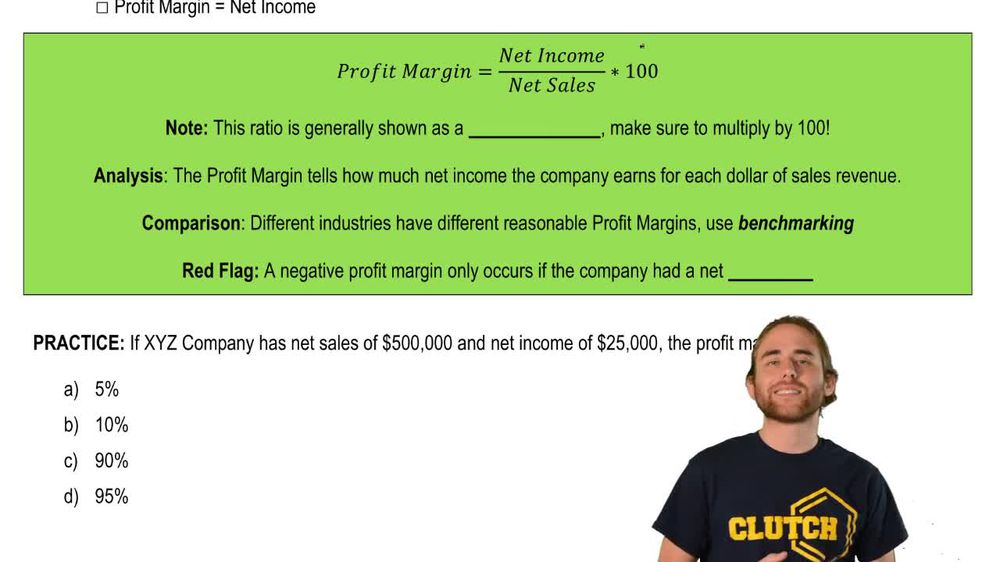
 03:08
03:08