Skip to main content
Financial Accounting
Il mio corso
Impara
Preparazione agli esami
AI Tutor
Guide di studio
Flashcard
Esplora
Prova l'app
Il mio corso
Impara
Preparazione agli esami
AI Tutor
Guide di studio
Flashcard
Esplora
Prova l'app
Indietro
Useful Information definitions
2 Gli studenti hanno trovato questo utile
Puoi toccare per girare la carta.
Relevance
Puoi toccare per girare la carta.
👆
Relevance
Quality of information that influences users' decisions by providing predictive and confirmatory value.
Avanzamenti del tracciato
I pulsanti di controllo sono stati cambiati in modalità "navigazione".
1/19
Flashcard correlate
Pratica correlata
Video consigliati
Useful Information quiz #1
Useful Information
40 Termini
Useful Information quiz #2
Useful Information
11 Termini
Useful Information
1. Introduction to Accounting
10 Problemi
Argomento
Fundamental Accounting Equation
1. Introduction to Accounting
10 Problemi
Argomento
1. Introduction to Accounting
7 Argomenti
15 Problemi
Capitolo
VideoThumbView.guidedCourse
03:43
Enhancing Characteristics
6159
views
203
rank
VideoThumbView.guidedCourse
02:49
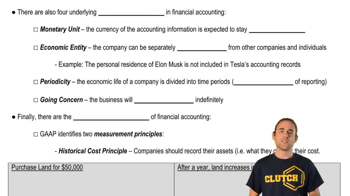
Four Underlying Assumptions
5403
views
163
rank
VideoThumbView.guidedCourse
03:16
Fundamental Qualitative Characteristics
9004
views
295
rank
1
comments
Termini in questo insieme (19)
Nascondere definizioni
Relevance
Quality of information that influences users' decisions by providing predictive and confirmatory value.
Predictive Value
Ability of information to help users forecast future outcomes or trends.
Confirmatory Value
Capacity of information to validate or refute previous predictions made by users.
Faithful Representation
Quality ensuring information is complete, unbiased, and free from significant errors.
Completeness
Extent to which all necessary and relevant details are included in the information provided.
Neutrality
Absence of bias in information, ensuring it is presented without favoring any side.
Material Error
Significant inaccuracy in information that could influence users' decisions, depending on company size.
Comparability
Characteristic allowing information to be consistently evaluated across different companies and time periods.
Verifiability
Quality that enables independent confirmation of information accuracy through evidence or audit.
Timeliness
Availability of information to users early enough to impact their decision-making process.
Understandability
Clarity and transparency of information, making it easily comprehensible to users.
Monetary Unit Assumption
Presumption that financial records use a stable currency, disregarding inflation effects.
Economic Entity Assumption
Separation of business activities from those of owners or other entities in financial reporting.
Periodicity Assumption
Division of a company's economic life into consistent time intervals for reporting purposes.
Going Concern Assumption
Expectation that a business will continue operating indefinitely, not liquidating in the near future.
Historical Cost Principle
Requirement to record assets at their original purchase price, regardless of current market value.
Fair Value Principle
Mandate to report certain assets at their current market value, reflecting up-to-date worth.
Full Disclosure Principle
Obligation to reveal all information that could affect users' decisions, beyond just numerical data.
Cost Constraint
Limitation where the benefit of providing information must outweigh the cost of obtaining it.
 IndietroIndietro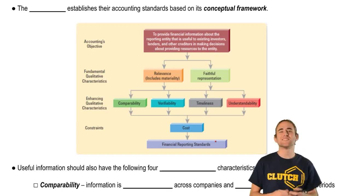
 03:43
03:43