Skip to main content
General Chemistry
Il mio corso
Impara
Preparazione agli esami
AI Tutor
Guide di studio
Soluzioni per libri di testo
Flashcard
Esplora
Prova l'app
Il mio corso
Impara
Preparazione agli esami
AI Tutor
Guide di studio
Soluzioni per libri di testo
Flashcard
Esplora
Prova l'app
Indietro
Chromatography quiz
Puoi toccare per girare la carta.
What does GCMS stand for?
Puoi toccare per girare la carta.
👆
What does GCMS stand for?
GCMS stands for Gas Chromatography Mass Spectrometry.
Avanzamenti del tracciato
I pulsanti di controllo sono stati cambiati in modalità "navigazione".
1/10
Flashcard correlate
Pratica correlata
Video consigliati
Chromatography definitions
Chromatography
15 Termini
Chromatography quiz #1
Chromatography
10 Termini
Chromatography quiz
Chromatography
15 Termini
Chromatography
4. BONUS: Lab Techniques and Procedures
10 Problemi
Argomento
Filtration and Evaporation
4. BONUS: Lab Techniques and Procedures
10 Problemi
Argomento
4. BONUS: Lab Techniques and Procedures
7 Argomenti
15 Problemi
Capitolo
VideoThumbView.guidedCourse
04:50
Chromatography
5394
views
12
rank
Termini in questo insieme (10)
Nascondere definizioni
What does GCMS stand for?
GCMS stands for Gas Chromatography Mass Spectrometry.
Which substance is not a type of chromatography?
Mass Chromatography is not a type of chromatography.
Which chromatography technique separates molecules based on size?
Gel Filtration Chromatography separates molecules based on size.
What is the stationary phase in chromatography typically made of?
The stationary phase in chromatography is typically made of a silica plate.
What is the role of the mobile phase in chromatography?
The mobile phase in chromatography is a solvent that moves through capillary action, carrying components at different rates.
How is the Retention Factor (Rf value) calculated in chromatography?
The Rf value is calculated as the ratio of the distance traveled by the compound to the distance traveled by the solvent.
What does a higher Rf value indicate about a compound's affinity in chromatography?
A higher Rf value indicates a greater affinity for the solvent compared to the stationary phase.
What happens to components with a higher affinity for the stationary phase in chromatography?
Components with a higher affinity for the stationary phase do not move far up the plate, showing low movement.
What is the purpose of using a TLC plate in chromatography?
A TLC plate is used to spot the mixture and observe the separation of components based on their affinities.
How can the identity of compounds be determined using chromatography?
The identity of compounds can be determined by comparing their Rf values to known values in a manual.
 IndietroIndietro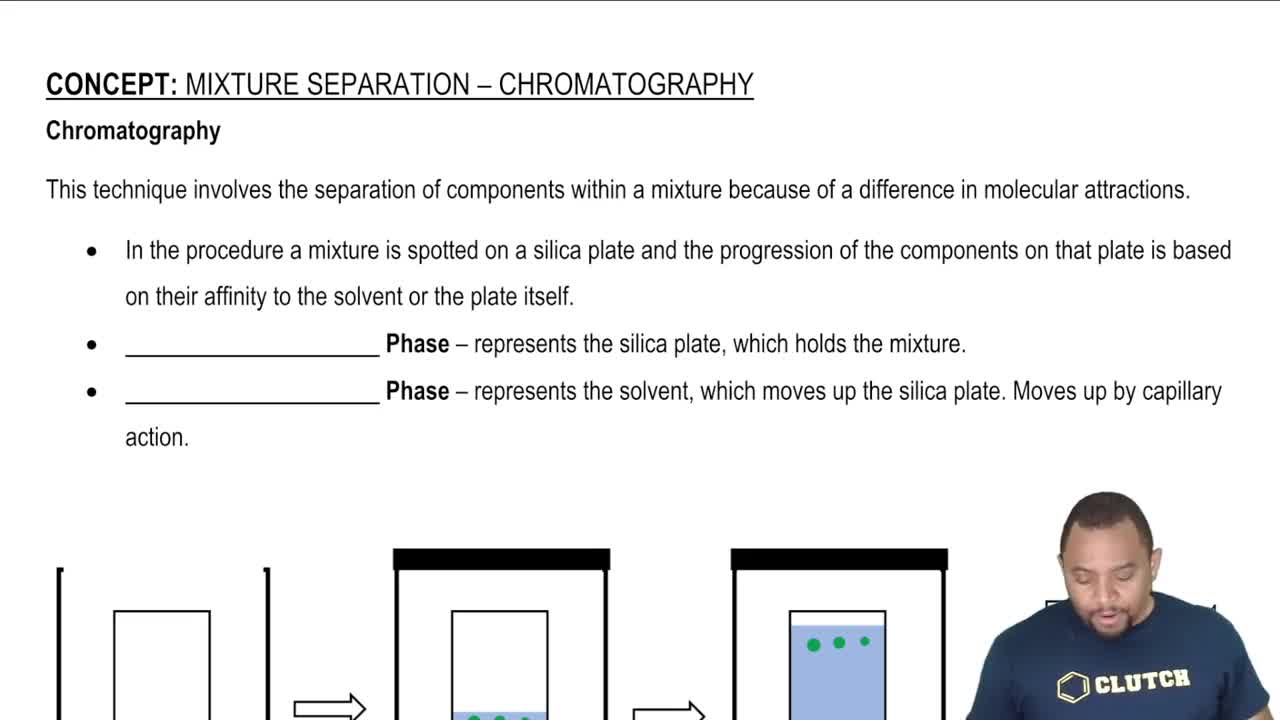
 04:50
04:50