Skip to main content
General Chemistry
Il mio corso
Impara
Preparazione agli esami
AI Tutor
Guide di studio
Soluzioni per libri di testo
Flashcard
Esplora
Prova l'app
Il mio corso
Impara
Preparazione agli esami
AI Tutor
Guide di studio
Soluzioni per libri di testo
Flashcard
Esplora
Prova l'app
Indietro
Logarithmic Functions quiz
Puoi toccare per girare la carta.
What does log(10) equal and why?
Puoi toccare per girare la carta.
👆
What does log(10) equal and why?
Log(10) equals 1 because 10 raised to the power of 1 is 10.
Avanzamenti del tracciato
I pulsanti di controllo sono stati cambiati in modalità "navigazione".
1/15
Flashcard correlate
Pratica correlata
Video consigliati
Power and Root Functions definitions
Logarithmic Functions
15 Termini
Power and Root Functions quiz #1
Logarithmic Functions
21 Termini
Logarithmic Functions
5. BONUS: Mathematical Operations and Functions
10 Problemi
Argomento
The Quadratic Formula
5. BONUS: Mathematical Operations and Functions
10 Problemi
Argomento
5. BONUS: Mathematical Operations and Functions
5 Argomenti
15 Problemi
Capitolo
VideoThumbView.guidedCourse
04:24
Inverse Logarithmic Functions
4594
views
8
rank
1
comments
VideoThumbView.guidedCourse
02:16
Logarithmic Functions Example
3698
views
8
rank
VideoThumbView.guidedCourse
03:37
Logarithmic Functions
4327
views
5
rank
1
comments
Termini in questo insieme (15)
Nascondere definizioni
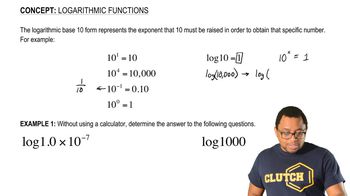
What does log(10) equal and why?
Log(10) equals 1 because 10 raised to the power of 1 is 10.
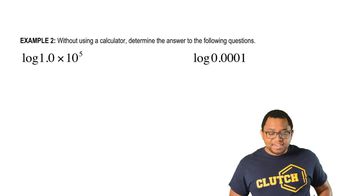
How do you express log(10000) in terms of exponents, and what is its value?
Log(10000) is log(10^4), which equals 4 because 10 to the 4th power is 10000.
What is the value of log(0.10) and how is it derived?
Log(0.10) equals -1 because 0.10 is 10 to the power of -1.
Why does log(1) always equal 0?
Log(1) equals 0 because any number raised to the power of 0 is 1.
What is the antilog of a number y if log(x) = y?
The antilog is 10^y, which gives back the original number x.
How is the antilog function used in the Henderson-Hasselbalch equation?
The antilog is used to solve for the ratio of conjugate base to weak acid by raising 10 to the power of the difference between pH and pKa.
What does the natural logarithm (ln) of a number represent?
The natural logarithm of a number is the power to which e must be raised to yield that number.
If ln(x) = y, what is the value of x?
x equals e^y, which is the inverse of the natural logarithm.
How do you simplify log(a × b) using logarithm properties?
Log(a × b) simplifies to log(a) + log(b).
What is the logarithmic property for division, log(a/b)?
Log(a/b) equals log(a) minus log(b).
How do you handle exponents in logarithms, such as log(a^x)?
Log(a^x) equals x times log(a); the exponent moves in front of the log.
How do you express the logarithm of an nth root, such as log(a^(1/x))?
Log(a^(1/x)) equals (1/x) times log(a).
If log(3) ≈ 0.48 and log(2) ≈ 0.30, how can you find log(12) without a calculator?
Log(12) = log(3) + log(2) + log(2) = 0.48 + 0.30 + 0.30 = 1.08.
When solving ln(x) = value, what operation do you perform to find x?
Take the exponential (e to the power of the value) to solve for x.
In what chemistry topic are natural logarithms (ln) commonly used?
Natural logarithms are commonly used in chemical kinetics.
 IndietroIndietro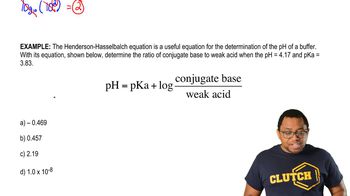
 04:24
04:24