Skip to main content
General Chemistry
Il mio corso
Impara
Preparazione agli esami
AI Tutor
Guide di studio
Soluzioni per libri di testo
Flashcard
Esplora
Prova l'app
Il mio corso
Impara
Preparazione agli esami
AI Tutor
Guide di studio
Soluzioni per libri di testo
Flashcard
Esplora
Prova l'app
Indietro
Molality quiz
Puoi toccare per girare la carta.
What is the definition of molality?
Puoi toccare per girare la carta.
👆
What is the definition of molality?
Molality is the number of moles of solute per kilogram of solvent.
Avanzamenti del tracciato
I pulsanti di controllo sono stati cambiati in modalità "navigazione".
1/15
Flashcard correlate
Pratica correlata
Video consigliati
Molality definitions
Molality
10 Termini
Molality quiz #1
Molality
14 Termini
Molality
14. Solutions
4 Problemi
Argomento
Jules
Parts per Million (ppm)
14. Solutions
4 Problemi
Argomento
Jules
14. Solutions - Part 1 of 3
4 Argomenti
12 Problemi
Capitolo
Jules
14. Solutions - Part 2 of 3
5 Argomenti
12 Problemi
Capitolo
Jules
14. Solutions - Part 3 of 3
5 Argomenti
12 Problemi
Capitolo
Jules
VideoThumbView.guidedCourse
00:40
Molality
6464
views
70
rank
VideoThumbView.guidedCourse
01:24
Osmolality in Solutions
4727
views
27
rank
1
comments
VideoThumbView.guidedCourse
02:19
Molality Calculation Example
5933
views
65
rank
Termini in questo insieme (15)
Nascondere definizioni
What is the definition of molality?
Molality is the number of moles of solute per kilogram of solvent.
Why is molality considered temperature independent?
Molality is temperature independent because it is based on mass, not volume, which does not change with temperature.
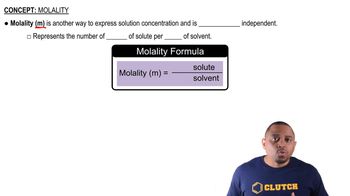
What is the formula for calculating molality?
Molality (m) = moles of solute / kilograms of solvent.
What does the lowercase 'm' symbolize in solution chemistry?
The lowercase 'm' symbolizes molality.
How does molality differ from molarity in terms of temperature dependence?
Molality does not change with temperature, while molarity can change because it depends on volume, which expands or contracts with temperature.
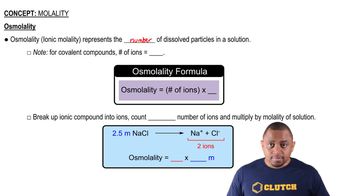
What is osmolality also known as?
Osmolality is also known as ionic molality.
How is osmolality calculated for ionic compounds?
Osmolality is calculated by multiplying the number of ions the compound dissociates into by the molality of the solution.
How many particles does a covalent compound contribute to osmolality?
A covalent compound contributes one particle to osmolality because it does not dissociate into ions.
What is the osmolality of a solution with 2.5 molal sodium chloride (NaCl)?
Since NaCl dissociates into 2 ions, the osmolality is 2 × 2.5 = 5 osmoles per kilogram of solvent.
Why do ionic compounds have higher osmolality than covalent compounds at the same molality?
Ionic compounds dissociate into multiple ions, increasing the number of particles in solution and thus the osmolality.
What is the unit for molality?
The unit for molality is moles of solute per kilogram of solvent (mol/kg).
If a solution contains 1 mole of glucose in 1 kg of water, what is its molality?
The molality is 1 mol/kg.
What is the main advantage of using molality over molarity in experiments involving temperature changes?
Molality remains constant with temperature changes, making it more reliable for such experiments.
How do you determine the number of ions for osmolality calculations in ionic compounds?
Count the total number of ions the compound dissociates into in solution.
What is the osmolality formula for a compound that dissociates into n ions?
Osmolality = number of ions × molality of the solution.
 IndietroIndietro
 00:40
00:40