Skip to main content
General Chemistry
Il mio corso
Impara
Preparazione agli esami
AI Tutor
Guide di studio
Soluzioni per libri di testo
Flashcard
Esplora
Prova l'app
Il mio corso
Impara
Preparazione agli esami
AI Tutor
Guide di studio
Soluzioni per libri di testo
Flashcard
Esplora
Prova l'app
Indietro
Multiplication and Division Operations quiz
Puoi toccare per girare la carta.
When multiplying numbers in scientific notation, what do you do with the coefficients and exponents?
Puoi toccare per girare la carta.
👆
When multiplying numbers in scientific notation, what do you do with the coefficients and exponents?
Multiply the coefficients and add the exponents.
Avanzamenti del tracciato
I pulsanti di controllo sono stati cambiati in modalità "navigazione".
1/15
Flashcard correlate
Pratica correlata
Video consigliati
Multiplication and Division Operations definitions
Multiplication and Division Operations
10 Termini
Multiplication and Division Operations quiz #1
Multiplication and Division Operations
10 Termini
Multiplication and Division Operations
5. BONUS: Mathematical Operations and Functions
10 Problemi
Argomento
Addition and Subtraction Operations
5. BONUS: Mathematical Operations and Functions
10 Problemi
Argomento
5. BONUS: Mathematical Operations and Functions
5 Argomenti
15 Problemi
Capitolo
VideoThumbView.guidedCourse
02:34
Scientific Notation Multiplication
3825
views
9
rank
1
comments
VideoThumbView.guidedCourse
02:10
Scientific Notation in Multiplication and Division
4364
views
9
rank
VideoThumbView.guidedCourse
03:10
Scientific Notation Mixed Operations
3564
views
12
rank
1
comments
Termini in questo insieme (15)
Nascondere definizioni
When multiplying numbers in scientific notation, what do you do with the coefficients and exponents?
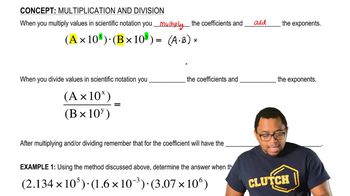
Multiply the coefficients and add the exponents.
How do you handle the coefficients and exponents when dividing numbers in scientific notation?
Divide the coefficients and subtract the exponents.
What is the correct scientific notation form for the coefficient?
The coefficient must be a number between 1 and less than 10.
After performing multiplication or division, how do you determine the number of significant figures in your answer?
Use the least number of significant figures from the coefficients used in the calculation.
What should you do if your coefficient after calculation is not between 1 and 10?
Adjust the decimal point and change the exponent accordingly to ensure the coefficient is between 1 and 10.
When multiplying (A × 10^x) × (B × 10^y), what is the resulting exponent?
The resulting exponent is x + y.
When dividing (A × 10^x) ÷ (B × 10^y), what is the resulting exponent?
The resulting exponent is x - y.
If you multiply 2.13 × 10^5, 1.66 × 10^-3, and 3.07 × 10^6, what do you do with the exponents?
Add the exponents: 5 + (-3) + 6 = 8.
How do you count significant figures in a coefficient with a decimal?
Start counting from the first nonzero digit and count all digits to the end.
If your calculated coefficient is 10.4822, how do you write it in proper scientific notation with 2 significant figures?
Write it as 1.0 × 10^1, adjusting the exponent to keep the coefficient between 1 and 10.
What happens to the exponent if you make the coefficient smaller to fit scientific notation?
The exponent increases by the number of places you move the decimal to the left.
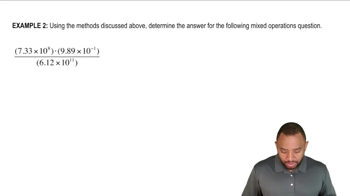
When performing mixed operations (multiplication and division), how do you handle the exponents?
Add exponents for multiplication and subtract exponents for division.
If all coefficients in a calculation have 3 significant figures, how many should your final answer have?
The final answer should have 3 significant figures.
Why is it important to use parentheses when entering scientific notation into a calculator?
Parentheses ensure the calculator interprets the numbers correctly and gives the right answer.
What is the rule for significant figures when adding or subtracting numbers (not multiplying or dividing)?
Use the least number of decimal places from the numbers involved.
 IndietroIndietro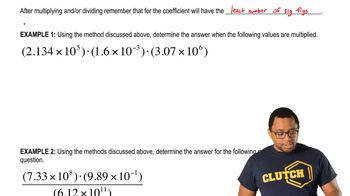
 02:34
02:34