Skip to main content
General Chemistry
Il mio corso
Impara
Preparazione agli esami
AI Tutor
Guide di studio
Soluzioni per libri di testo
Flashcard
Esplora
Prova l'app
Il mio corso
Impara
Preparazione agli esami
AI Tutor
Guide di studio
Soluzioni per libri di testo
Flashcard
Esplora
Prova l'app
Indietro
Power and Root Functions - quiz
Puoi toccare per girare la carta.
What happens to the coefficient when you raise a value in scientific notation to a power?
Puoi toccare per girare la carta.
👆
What happens to the coefficient when you raise a value in scientific notation to a power?
You raise the coefficient to that power.
Avanzamenti del tracciato
I pulsanti di controllo sono stati cambiati in modalità "navigazione".
1/15
Flashcard correlate
Pratica correlata
Video consigliati
Power and Root Functions - definitions
Power and Root Functions
10 Termini
Power and Root Functions - quiz #1
Power and Root Functions
10 Termini
Power and Root Functions -
5. BONUS: Mathematical Operations and Functions
10 Problemi
Argomento
Logarithmic Functions
5. BONUS: Mathematical Operations and Functions
10 Problemi
Argomento
5. BONUS: Mathematical Operations and Functions
5 Argomenti
15 Problemi
Capitolo
VideoThumbView.guidedCourse
04:42
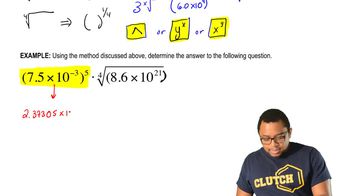
Power and Root Functions Example
4022
views
2
rank
2
comments
VideoThumbView.guidedCourse
01:53
Power and Root Functions Example
3824
views
7
rank
2
comments
Termini in questo insieme (15)
Nascondere definizioni
What happens to the coefficient when you raise a value in scientific notation to a power?
You raise the coefficient to that power.
How do you adjust the exponent when raising a scientific notation value to a power?
You multiply the exponent by the power.
What is the result of cubing 3.0 × 10⁻² in scientific notation before adjusting the coefficient?
It becomes 27 × 10⁻⁶.
Why must the coefficient in scientific notation be between 1 and 10?
This is the standard form for scientific notation to ensure consistency and clarity.
How do you adjust the exponent when you move the decimal point to make the coefficient between 1 and 10?
If you make the coefficient smaller, you increase the exponent by 1.
What is the final scientific notation for (3.0 × 10⁻²)³ after adjusting the coefficient?
It is 2.7 × 10⁻⁵.
What mathematical operation is equivalent to taking the nth root of a number?
It is the same as raising the number to the reciprocal power (1/n).
How do you handle the coefficient and exponent when taking the cube root of a scientific notation value?
Raise the coefficient to the 1/3 power and multiply the exponent by 1/3.
What is the cube root of 6.0 × 10⁹ expressed in scientific notation?
It is 1.8 × 10³.
How do you enter a root function on a calculator if it has a root button?
Press the root button, enter the root degree, open parenthesis, input the number, and close parenthesis.
What should you do if your calculator does not have a root button but has a power button?
Use the power button and raise the number to the reciprocal power, such as 1/3 for a cube root.
What is the equivalent operation for the square root in terms of powers?
The square root is the same as raising the number to the 1/2 power.
What is the equivalent operation for the fourth root in terms of powers?
The fourth root is the same as raising the number to the 1/4 power.
Why is it important to enter calculations precisely into your calculator?
Incorrect input can lead to wrong answers, regardless of understanding the setup.
What should you do after learning the operations for power and root functions in scientific notation?
Practice entering them into your calculator to ensure you get the correct answer.
 IndietroIndietro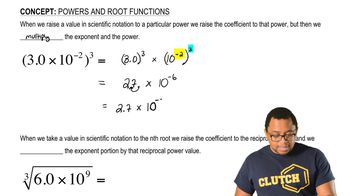
 04:42
04:42