Skip to main content
General Chemistry
Il mio corso
Impara
Preparazione agli esami
AI Tutor
Guide di studio
Soluzioni per libri di testo
Flashcard
Esplora
Prova l'app
Il mio corso
Impara
Preparazione agli esami
AI Tutor
Guide di studio
Soluzioni per libri di testo
Flashcard
Esplora
Prova l'app
Indietro
Reaction Quotient quiz
Puoi toccare per girare la carta.
What does the reaction quotient (Q) represent in a chemical reaction?
Puoi toccare per girare la carta.
👆
What does the reaction quotient (Q) represent in a chemical reaction?
Q is the ratio of product to reactant concentrations at a specific moment, not necessarily at equilibrium.
Avanzamenti del tracciato
I pulsanti di controllo sono stati cambiati in modalità "navigazione".
1/15
Flashcard correlate
Pratica correlata
Video consigliati
Reaction Quotient definitions
Reaction Quotient
15 Termini
Reaction Quotient
16. Chemical Equilibrium
5 Problemi
Argomento
Jules
ICE Charts
16. Chemical Equilibrium
7 Problemi
Argomento
Jules
16. Chemical Equilibrium - Part 1 of 2
5 Argomenti
13 Problemi
Capitolo
Jules
16. Chemical Equilibrium - Part 2 of 2
5 Argomenti
13 Problemi
Capitolo
Jules
VideoThumbView.guidedCourse
00:49
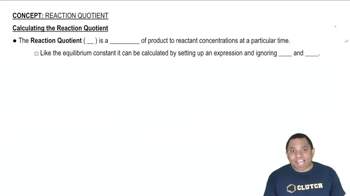
Reaction Quotient Q
3901
views
32
rank
VideoThumbView.guidedCourse
03:26
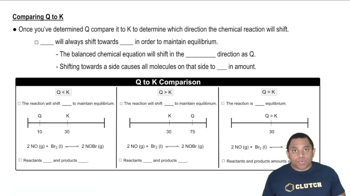
Comparing Q to K and Equilibrium Shift
3332
views
25
rank
VideoThumbView.guidedCourse
02:18
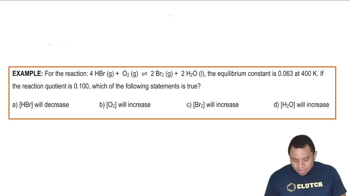
Comparing Q to K Example
2707
views
25
rank
Termini in questo insieme (15)
Nascondere definizioni
What does the reaction quotient (Q) represent in a chemical reaction?
Q is the ratio of product to reactant concentrations at a specific moment, not necessarily at equilibrium.
How is the reaction quotient (Q) similar to the equilibrium constant (K)?
Both Q and K are calculated using the ratio of product to reactant concentrations, ignoring solids and liquids.
What is the main difference between Q and K?
Q is calculated at any point in time, while K is calculated only at equilibrium.
What happens if Q < K for a reaction?
The reaction will shift to the right, increasing product concentration and decreasing reactant concentration to reach equilibrium.
What happens if Q > K for a reaction?
The reaction will shift to the left, increasing reactant concentration and decreasing product concentration to reach equilibrium.
What does it mean if Q = K?
The system is at equilibrium, and the concentrations of reactants and products remain constant.
When setting up the expression for Q, which phases are ignored?
Solids and liquids are ignored when calculating Q.
How does the direction of the reaction relate to the direction Q shifts to reach K?
The chemical reaction shifts in the same direction as Q moves to reach K.
If the reaction shifts toward the product side, what happens to the amounts of products and reactants?
Product amounts increase while reactant amounts decrease.
If the reaction shifts toward the reactant side, what happens to the amounts of reactants and products?
Reactant amounts increase while product amounts decrease.
Why is comparing Q to K important in chemical reactions?
It helps predict the direction the reaction will shift to reach equilibrium.
What is the value of Q if the system is at equilibrium?
Q is equal to K at equilibrium.
What happens to reactant and product concentrations when Q = K?
They remain unchanged or constant.
How can knowing Q help you in solving chemical reaction problems?
By comparing Q to K, you can determine which direction the reaction will shift to maintain equilibrium.
What is the general rule for the reaction shift when Q is not equal to K?
The reaction will always shift in the direction that brings Q closer to K.
 IndietroIndietro
 00:49
00:49