 Indietro
Average Atomic Mass in General Chemistry
 5:41
5:41
Termini in questo insieme (20)
Average atomic mass is the weighted average mass of the atoms in a naturally occurring element, based on the masses and relative abundances of its isotopes.
Multiply the mass of each isotope by its fractional abundance, then sum these values: \(\text{Average Atomic Mass} = \sum (\text{isotope mass} \times \text{fractional abundance})\).
Fractional abundance is the decimal form of the percentage abundance of an isotope, representing its proportion in nature.
Because it is a weighted average of isotopes with different masses and abundances, resulting in a decimal value.
Atomic mass is measured in atomic mass units (amu), where 1 amu is defined as one twelfth the mass of a carbon-12 atom.
Calculate: (10 × 0.20) + (11 × 0.80) = 2 + 8.8 = 10.8 amu.
You need the mass and relative abundance of each isotope of the element.
Isotopes with higher abundance contribute more to the average atomic mass.
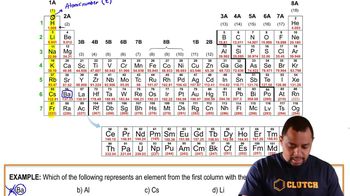
The atomic mass listed on the periodic table is the average atomic mass of all isotopes of that element.
No, average atomic mass represents a mixture of isotopes, not individual isotope masses.
Atomic mass is the weighted average of isotopes; mass number is the total number of protons and neutrons in a single isotope.
Divide the percent abundance by 100.
Because it is a stable isotope with exactly 12 amu, providing a consistent reference point.
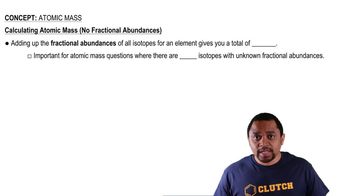
The calculation is incorrect; fractional abundances must sum to 1 (or 100%).
Average atomic mass in amu is numerically equal to the molar mass in grams per mole.
An isotope is an atom of the same element with different numbers of neutrons and different mass.
Contribution = 35 × 0.75 = 26.25 amu.
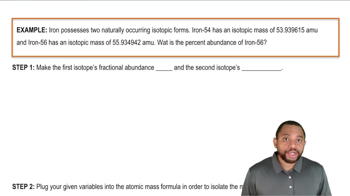
\(\text{Average Atomic Mass} = (m_1 \times f_1) + (m_2 \times f_2)\), where m is mass and f is fractional abundance.
It allows chemists to calculate the mass of elements in compounds and reactions accurately.
Verify that fractional abundances sum to 1 and that the weighted sum matches expected values.