 Indietro
Ch 1 Flashcards
 01:34
01:34

Termini in questo insieme (21)
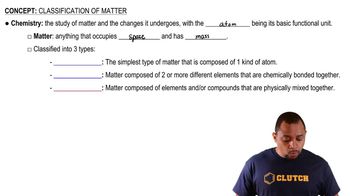
Chemistry is the study of matter, its properties, and the changes it undergoes.
The three states of matter are solid, liquid, and gas.
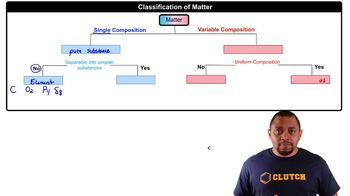
A substance has distinct properties and a composition that does not vary from sample to sample.
An element cannot be decomposed into simpler substances, while a compound can be decomposed because it contains two or more elements.
Atoms are the building blocks of matter; molecules are groups of atoms bonded together.
Elements are represented by symbols, usually one or two letters, with the first letter capitalized.
Compounds have a definite composition, meaning the relative number of atoms of each element is the same in any sample.
Homogeneous mixtures have uniform composition throughout; heterogeneous mixtures do not.
Physical properties can be observed without changing the substance, such as color, density, and melting point.
Chemical properties can only be observed when a substance changes into another, such as flammability.
Intensive properties do not depend on amount (e.g., density), while extensive properties depend on amount (e.g., mass).
Physical changes do not change composition (e.g., melting), while chemical changes produce new substances (e.g., combustion).
Mixtures can be separated by filtration, distillation, and chromatography.
Energy is the capacity to do work or transfer heat.
Kinetic energy is energy of motion; potential energy is stored energy based on position.
The SI base unit for mass is the kilogram (kg).
The SI unit is the Kelvin (K), related by \(K=\degree C+273.15\).
Density is mass per volume, commonly in g/mL or g/cm3.
Significant figures include all certain digits plus one uncertain digit in a measurement.
Results are reported with the same number of significant figures as the measurement with the fewest significant figures.
Dimensional analysis uses conversion factors to change units systematically.