A periodic property is a physical or chemical property of an element that is predictable based on its position in the periodic table.
What does the Periodic Law state?
The Periodic Law states that when elements are arranged in order of increasing atomic mass, certain sets of properties recur periodically.
How are elements arranged in the modern periodic table?
Elements are arranged in order of increasing atomic number, with rows called periods and columns called groups or families.
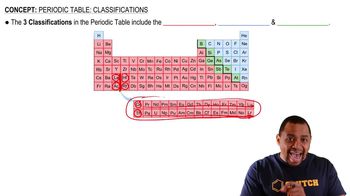
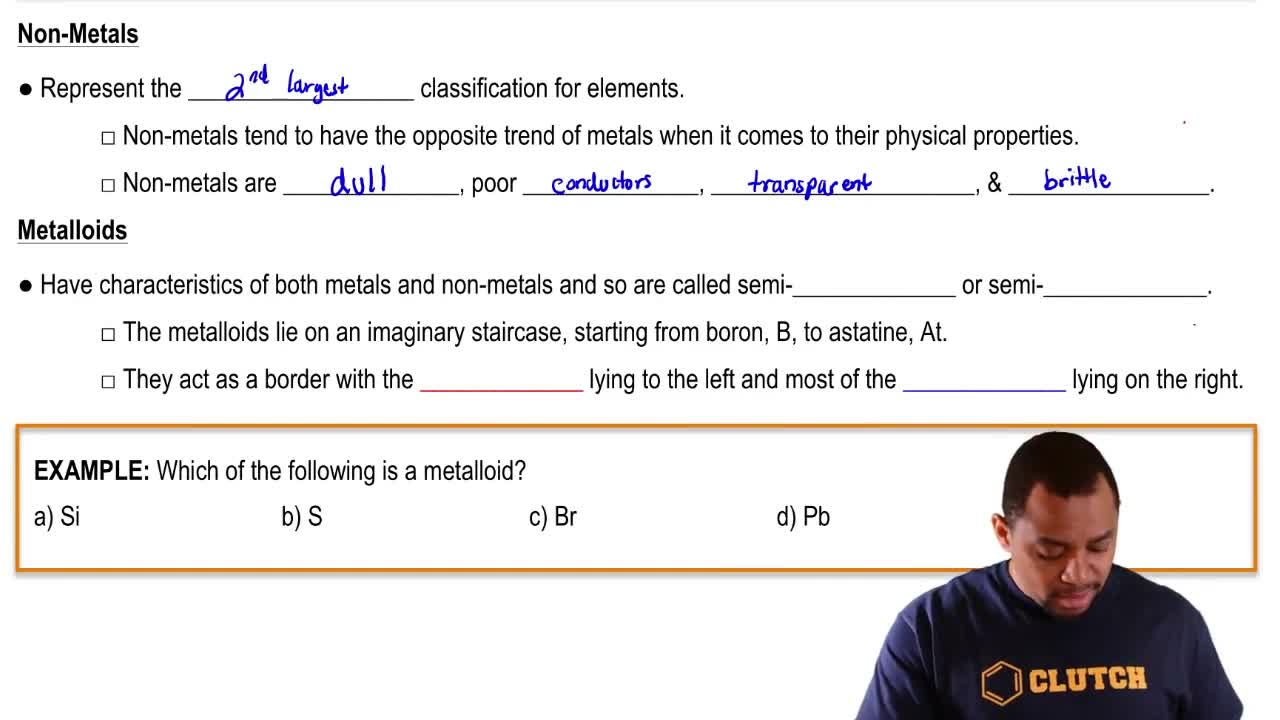
What are the main classifications of elements in the periodic table?
Elements are classified as metals, nonmetals, and metalloids. They are also divided into main-group elements (A) and transition elements (B).
What is an electron configuration?
An electron configuration describes the arrangement of electrons in an atom's orbitals.
What is the Pauli Exclusion Principle?
No two electrons in an atom can have the same set of four quantum numbers; thus, an orbital can hold a maximum of two electrons with opposite spins.
What is electron spin and its significance?
Electron spin is a fundamental property with two possible orientations (up or down). Paired electrons in an orbital must have opposite spins.
What causes sublevel energy splitting in multi-electron atoms?
Sublevel splitting is caused by electron-electron interactions, shielding, and penetration effects, making sublevels in the same principal energy level have different energies.
What is shielding in atoms?
Shielding occurs when inner electrons reduce the effective nuclear charge felt by outer electrons by repelling them.
What is penetration in atomic orbitals?
Penetration refers to how an electron in a sublevel can get closer to the nucleus, experiencing less shielding and a stronger attraction.
What is the aufbau principle?
Electrons fill atomic orbitals starting from the lowest energy level to higher energy levels.
What is Hund's Rule?
When filling degenerate orbitals, electrons occupy them singly with parallel spins before pairing up.
How do you determine valence electrons from electron configuration?
Valence electrons are the electrons in the outermost principal energy level (highest n value) of an atom.
How do main-group elements' group numbers relate to valence electrons?
The group number of a main-group element equals the number of valence electrons it has.
What is the general trend of atomic radius in the periodic table?
Atomic radius increases down a group and decreases across a period from left to right.
What is effective nuclear charge (Z_eff)?
Effective nuclear charge is the net positive charge experienced by an electron after accounting for shielding by other electrons.
How does ionization energy change across the periodic table?
Ionization energy generally increases across a period and decreases down a group.
What is electron affinity?
Electron affinity is the energy change when an electron is added to a neutral atom in the gas phase, often releasing energy (exothermic).
What is metallic character and its periodic trend?
Metallic character describes how closely an element's properties match those of metals; it decreases across a period and increases down a group.
How do cation and anion sizes compare to their neutral atoms?
Cations are smaller than their neutral atoms due to loss of electrons and increased effective nuclear charge; anions are larger due to added electrons and increased electron-electron repulsion.
 Indietro
 01:12
01:12