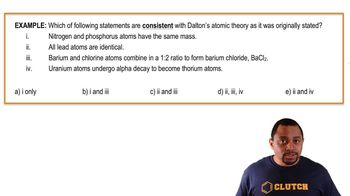
Each element is composed of extremely small particles called atoms.
Dalton's Atomic Theory - Postulate 2
All atoms of a given element are identical in mass and properties, but differ from atoms of other elements.
Dalton's Atomic Theory - Postulate 3
Atoms are neither created nor destroyed in chemical reactions; atoms of one element cannot change into another.
Dalton's Atomic Theory - Postulate 4
Atoms of different elements combine in fixed ratios to form compounds with the same relative number and kind of atoms.
Law of Conservation of Mass
The total mass of substances before and after a chemical process remains constant.
Law of Constant Composition
Compounds have a definite composition with the same relative number of atoms of each element in any sample.
Law of Multiple Proportions
If two elements form more than one compound, the masses of one element that combine with a fixed mass of the other are in ratios of small whole numbers.
Discovery of the Electron
J. J. Thomson discovered the electron as a negatively charged particle in 1897 using cathode ray tubes.
Millikan Oil-Drop Experiment
Measured the charge of the electron as 1.602 x 10⁻¹⁹ coulombs, allowing calculation of electron mass.
Radioactivity
Spontaneous emission of high-energy radiation by atoms, discovered by Henri Becquerel and studied by Marie and Pierre Curie.
Types of Radioactive Radiation
Alpha (α) particles are positive, beta (β) particles are negative, and gamma (γ) rays are uncharged.
Thomson's Plum Pudding Model
Atom modeled as a positive sphere with embedded negative electrons, later disproved by Rutherford's experiments.
Rutherford's Gold Foil Experiment
Discovered the nucleus by observing deflection of alpha particles, showing atoms have a small, dense positive center.
Subatomic Particles and Charges
Protons (+1), neutrons (neutral), and electrons (-1) make up atoms; protons and neutrons are in the nucleus.
Atomic Number
Number of protons in the nucleus; defines the element and equals the number of electrons in a neutral atom.
Isotopes
Atoms of the same element with different numbers of neutrons and different mass numbers.
Atomic Mass Unit (amu)
Unit of atomic mass; 1 amu = 1.66053907 x 10⁻²⁴ g, based on 1/12 the mass of a carbon-12 atom.
Atomic Weight
Weighted average mass of an element's isotopes based on their natural abundance.
Periodic Table Organization
Elements arranged by increasing atomic number in rows called periods and columns called groups with similar properties.
 Indietro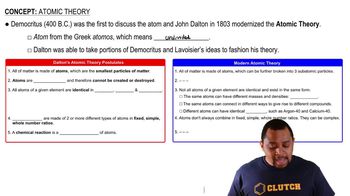
 05:22
05:22