 Indietro
General Chemistry: Atomic Theory, Energy, and Quantum Mechanics
 01:20
01:20
Termini in questo insieme (27)
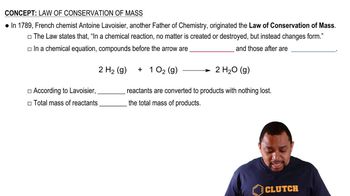
Matter is neither created nor destroyed in a chemical reaction.
When two elements form different compounds, the masses of one element that combine with 1 g of the other are in ratios of small whole numbers.
1. Elements are made of indestructible atoms.
2. Atoms of an element are identical.
3. Atoms combine in whole number ratios.
4. Atoms cannot change into other elements.
Isotopes contradict Dalton's idea that all atoms of an element are identical because they have different numbers of neutrons.
Endothermic: system gains energy.
Exothermic: system loses energy.
Fusion (s → l), Vaporization (l → g), Sublimation (s → g) are endothermic phase changes.
Freezing (l → s), Condensation (g → l), Deposition (g → s) are exothermic phase changes.
Precision: consistency of measurements.
Accuracy: closeness to the true value.
Kelvin (K) is an absolute temperature scale starting at 0 K; conversion: \(K=C+273.15\).
Density (d) = mass (m) / volume (v); density is an intensive property.
Pure substance: one component with fixed composition.
Mixture: two or more components varying in composition.
Protons (+), Neutrons (0), Electrons (-).
Atom has a small, dense, positively charged nucleus; most of the atom is empty space with electrons dispersed.
Neutrons have no charge, slightly heavier than protons, and shield protons from repelling each other in the nucleus.
Number of protons in an atom; defines the element.
1 mole = 6.022 x 10²³ particles; number of atoms in 12 g of carbon-12.
Atoms of the same element with different numbers of neutrons but the same number of protons.
Cations: positively charged, lost electrons.
Anions: negatively charged, gained electrons.
Frequency (v) and wavelength (λ) are inversely proportional: \(v \times \lambda = c\), where c is speed of light.
Electrons are ejected from a metal only if light has a frequency above a threshold; explained by photons with energy \(E=hv\).
Electrons orbit nucleus in fixed energy levels; emit photons when jumping to lower energy orbits.
It is impossible to know both the exact position and momentum of an electron simultaneously.
Indicates the energy level of an electron; n ≥ 1; higher n means higher energy and larger orbitals.
Determines orbital shape; values from 0 to n-1; s (0), p (1), d (2), f (3) orbitals.
Specifies orbital orientation; values from -l to +l including zero.
Electron spin can be +1/2 (spin up) or -1/2 (spin down); two electrons in an orbital must have opposite spins.
No two electrons in an atom can have the same set of four quantum numbers (n, l, ml, ms).