 Indietro
General Chemistry: Atoms and Elements
 02:53
02:53
Termini in questo insieme (20)
An atom is the smallest identifiable unit of an element, composed of protons, neutrons, and electrons.
The word atom comes from the Greek atomos, meaning "indivisible." Atoms cannot be divided into smaller pieces and still retain their elemental identity.
Leucippus and Democritus proposed that matter is made of small, indestructible particles called atoms that move randomly through empty space.
The law of conservation of mass, law of definite proportions, and law of multiple proportions were key to developing atomic theory.
In a chemical reaction, matter is neither created nor destroyed; the total mass of substances remains constant.
Dalton's theory states: 1) Elements are made of atoms, 2) Atoms of an element are identical, 3) Atoms combine in whole-number ratios to form compounds, 4) Atoms cannot change into other atoms in reactions.
Thomson discovered the electron, a negatively charged, low-mass particle present in all atoms.
Thomson measured the electron's charge-to-mass ratio by deflecting cathode rays with electric and magnetic fields.
Millikan's experiment measured the charge of a single electron by balancing gravitational and electric forces on charged oil droplets.
Thomson's model proposed electrons embedded in a positively charged sphere, like plums in pudding.
It showed that atoms have a small, dense, positively charged nucleus and mostly empty space, disproving the plum-pudding model.
1) Most mass and positive charge in nucleus, 2) Electrons dispersed in empty space, 3) Equal number of protons and electrons for neutrality.
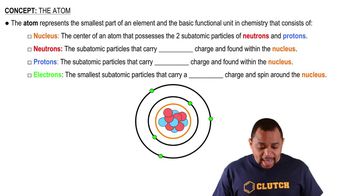
Neutrons are neutral particles in the nucleus with mass similar to protons, contributing to atomic mass but no charge.
Protons (+1 charge), Neutrons (0 charge), Electrons (-1 charge).
The number of protons in the nucleus, called the atomic number (Z), defines the element.
Atoms of the same element with the same number of protons but different numbers of neutrons.
Mass number A = number of protons + number of neutrons.
Atomic mass is the weighted average of the masses of an element's isotopes based on their natural abundance.
Isotopes are denoted as \(^A_ZX\), where X is the element symbol, A is mass number, and Z is atomic number.
Natural abundance is the percentage of each isotope present in a natural sample, affecting the element's average atomic mass.