 Indietro
General Chemistry: Atoms and Elements
 02:53
02:53
Termini in questo insieme (26)
An atom is the smallest identifiable unit of an element that retains the element's properties.
The word atom comes from the Greek atomos, meaning indivisible.
He observed that particles suspended in water were in continuous motion, caused by collisions with atoms or molecules.
Einstein developed a theory explaining Brownian motion; Perrin experimentally confirmed it, supporting the particulate nature of matter.
The law of conservation of mass, law of definite proportions, and law of multiple proportions.
In a chemical reaction, matter is neither created nor destroyed; total mass remains constant.
All samples of a given compound have the same proportions of their constituent elements by mass.
When two elements form different compounds, the masses of one element that combine with a fixed mass of the other are in ratios of small whole numbers.
Atoms are tiny, indestructible particles; atoms of an element are identical; atoms combine in whole-number ratios; atoms rearrange in reactions but do not change into other atoms.
He discovered the electron, a negatively charged, low-mass particle within atoms, using cathode ray experiments.
It measured the charge of a single electron by balancing gravitational and electric forces on charged oil drops.
Most alpha particles passed through gold foil, but some were deflected or bounced back, indicating a small, dense, positively charged nucleus.
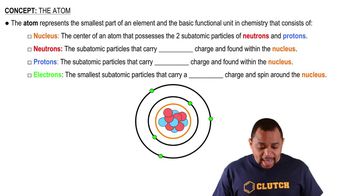
Most mass and positive charge are in a small nucleus; electrons occupy empty space around it; atoms are electrically neutral.
Neutrons are neutral particles in the nucleus with mass similar to protons but no charge.
The number of protons in its nucleus, called the atomic number (Z).
Atoms of the same element with the same number of protons but different numbers of neutrons.
Mass number = number of protons + number of neutrons in an atom.
Charged atoms formed by loss or gain of electrons; cations are positive, anions are negative.
When elements are arranged by increasing atomic number, their properties recur periodically.
Metals, nonmetals, and metalloids.
Good conductors, malleable, ductile, shiny, tend to lose electrons in reactions.
Poor conductors, not malleable or ductile, tend to gain electrons in reactions.
Elements with mixed properties between metals and nonmetals, often semiconductors.
A unit representing Avogadro's number (\(6.022\times10^{23}\)) of particles.
Molar mass (g/mol) is numerically equal to the atomic mass (amu) of an element.
Atomic mass = sum of (isotope mass × fractional natural abundance) for all isotopes.