 Indietro
General Chemistry: Atoms and Matter Fundamentals
 01:34
01:34

Termini in questo insieme (30)
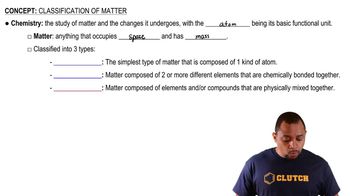
Matter is anything that has mass and occupies space (has volume).
Atoms are basic submicroscopic particles that constitute the fundamental building blocks of ordinary matter.
Molecules are particles formed when two or more atoms bond together in specific geometric arrangements.
Matter is classified as solid, liquid, or gas based on physical properties and particle arrangement.
In solids, atoms or molecules are tightly packed in fixed locations, vibrate but do not move past each other, giving solids a fixed volume and rigid shape.
In liquids, atoms or molecules are closely packed but free to move relative to each other, giving liquids a fixed volume but no fixed shape.
In gases, atoms or molecules are spaced far apart and move freely, making gases compressible and able to fill their containers.
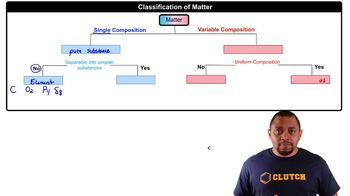
Matter is classified as pure substances (elements or compounds) or mixtures (heterogeneous or homogeneous) based on particle uniformity.
A pure substance has a fixed, invariant composition and can be an element or a compound.
An element is a substance that cannot be chemically broken down into simpler substances and is composed of one type of atom.
A compound is a substance composed of two or more elements in fixed, definite proportions.
A mixture contains two or more components in variable proportions and can be heterogeneous or homogeneous.
A heterogeneous mixture has a composition that varies from one region to another, with visibly different substances.
A homogeneous mixture has uniform composition and properties throughout, appearing as a single substance.
The scientific method is an empirical process involving observation, hypothesis formulation, experimentation, and theory or law development.
A hypothesis is a tentative explanation for observations that is falsifiable and testable by experiments.
A scientific law summarizes past observations and predicts future ones, such as the law of conservation of mass.
A theory explains why natural phenomena occur, is well-established, testable, and can predict future observations.
Dalton's atomic theory states that elements are made of atoms, atoms of an element are identical, atoms combine in whole-number ratios, and atoms cannot change into other atoms.
The law of conservation of mass states that matter is neither created nor destroyed in a chemical reaction.
The law of definite proportions states that all samples of a compound have the same proportions of constituent elements.
The law of multiple proportions states that when two elements form different compounds, the masses of one element that combine with a fixed mass of the other are in ratios of small whole numbers.
Atoms are composed of protons, neutrons, and electrons.
Protons have a positive charge (+1) and a mass of approximately 1 atomic mass unit (amu).
Neutrons have no charge (0) and a mass similar to protons (~1 amu).
Electrons have a negative charge (-1) and a much smaller mass (~0.00055 amu).
The atomic number (Z), the number of protons in the nucleus, defines the element.
Isotopes are atoms of the same element with the same number of protons but different numbers of neutrons.
A mole is a unit representing \(6.022\times10^{23}\) particles, the number of atoms in 12 grams of carbon-12.
Molar mass is the mass of one mole of atoms of an element, numerically equal to the element's atomic mass in amu but expressed in grams per mole.