What defines a neutral atom in terms of protons and electrons?
A neutral atom has an equal number of protons and electrons.
What are ions and how are they formed?
Ions are charged particles formed when atoms lose or gain electrons during chemical changes.
What is a cation?
A cation is a positively charged ion formed by losing electrons.
What is an anion?
An anion is a negatively charged ion formed by gaining electrons.
How does the size of isotopes of the same element compare?
Isotopes with more neutrons are generally larger than those with fewer neutrons.
What is the Periodic Law as stated by Mendeleev?
When elements are arranged by increasing mass, certain sets of properties recur periodically.
How did Mendeleev organize the periodic table?
He arranged elements in rows by increasing mass so that elements with similar properties fall in the same vertical columns.
What was significant about the gaps in Mendeleev's periodic table?
They allowed him to predict the existence and properties of undiscovered elements.
How is the modern periodic table arranged differently from Mendeleev's?
Elements are arranged by increasing atomic number rather than atomic mass.
What are the three main classifications of elements in the periodic table?
Metals, nonmetals, and metalloids.
List common properties of metals.
Good conductors of heat and electricity, malleable, ductile, shiny, and tend to lose electrons in chemical changes.
List common properties of nonmetals.
Poor conductors, not malleable or ductile, tend to gain electrons in chemical changes, and have varied physical states.
What are metalloids and their key property?
Elements along the zigzag line between metals and nonmetals with mixed properties, often semiconductors.
What are main-group elements and transition elements?
Main-group elements have largely predictable properties based on position; transition elements have less predictable properties.
How many groups and periods are in the periodic table?
There are 18 groups (vertical columns) and 7 periods (horizontal rows).
What are noble gases and their key characteristic?
Group 18 elements that are mostly unreactive and chemically stable.
What are alkali metals and a notable property?
Group 1 reactive metals that lose one electron and react violently with water.
What are alkaline earth metals and their reactivity?
Group 2 metals that are fairly reactive but less so than alkali metals, typically lose two electrons.
What are halogens and their reactivity?
Group 17 very reactive nonmetals that tend to gain one electron.
How do main-group metals and nonmetals form ions relative to noble gases?
Main-group metals lose electrons to form cations with the same electron count as the nearest noble gas; nonmetals gain electrons to form anions similarly.
How is the charge of ions from main-group elements predicted?
Cation charge equals the group number; anion charge equals group number minus eight.
 Indietro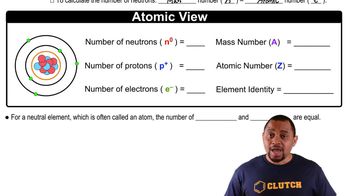
 04:36
04:36