 Indietro
General Chemistry: Basic Concepts and Atomic Structure
 01:40
01:40
Termini in questo insieme (27)
Length: meter (m), Mass: kilogram (kg), Time: second (s), Temperature: kelvin (K), Amount of substance: mole (mol), Electric current: ampere (A), Luminous intensity: candela (cd).
Common prefixes include Giga (109), Mega (106), Kilo (103), Deci (10-1), Centi (10-2), Milli (10-3), Micro (10-6), Nano (10-9), Pico (10-12).
Digits in a measured number including all certain digits plus one uncertain digit. Leading zeros are not significant; trailing zeros are significant if after a decimal point.
Multiplication/Division: result has as many significant figures as the least precise factor.
Addition/Subtraction: result has as many decimal places as the least precise measurement.
Numbers that are counted or defined exactly, such as 12 inches = 1 foot, have infinite significant figures.
A method to convert units using conversion factors to ensure units cancel properly and the correct units remain.
Density is mass per unit volume, typically g/cm3 for solids/liquids and g/L for gases.
Solids: fixed shape and volume.
Liquids: fixed volume, no fixed shape.
Gases: no fixed volume or shape, easily compressed.
Cannot be separated by physical means.
Elements: one type of atom.
Compounds: two or more elements chemically combined.
Heterogeneous: physically distinct parts.
Homogeneous: uniform composition throughout.
Hypothesis: tentative explanation.
Experiment: controlled observation.
Theory: tested explanation.
Law: concise statement or equation.
Atoms of an element are identical.
Elements composed of atoms.
Compounds formed by atoms in whole number ratios.
Atoms rearranged in reactions.
Matter is neither created nor destroyed in a chemical reaction; total mass remains constant.
A compound always contains the same elements in the same fixed proportion by mass.
When two elements form more than one compound, the masses of one element combine with a fixed mass of the other in ratios of small whole numbers.
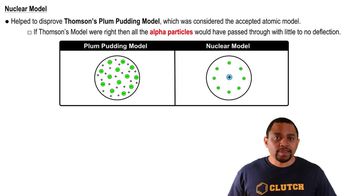
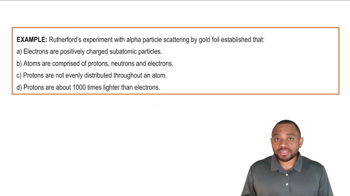
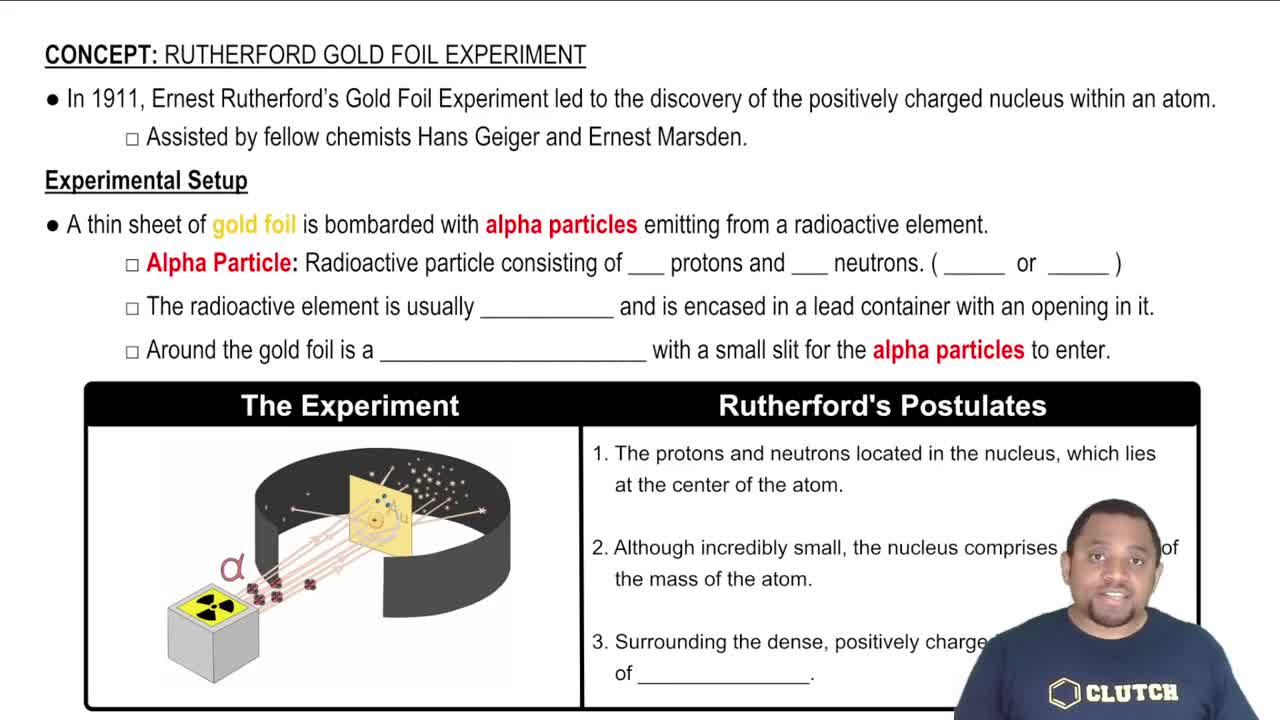
Atom consists of a nucleus (protons and neutrons) and electrons in the surrounding space.
Most mass and positive charge in nucleus.
Atom mostly empty space.
Number of electrons equals number of protons.
Number of protons in the nucleus; defines the element.
Total number of protons and neutrons in the nucleus.
Atoms of the same element with the same atomic number but different mass numbers due to varying neutrons.
One twelfth the mass of a carbon-12 atom; protons and neutrons have ~1 amu; electrons ~0 amu.
Weighted average of the atomic masses of an element's isotopes based on their natural abundance.
Elements arranged by increasing atomic number with groups (columns) and periods (rows) showing similar properties.
Examples: Alkali metals (Group IA), Alkaline earth metals (IIA), Halogens (VIIA), Noble gases (VIIIA).
Main group metals tend to lose electrons forming cations; nonmetals tend to gain electrons forming anions.
A mole contains Avogadro's number (\(6.022 \times 10^{23}\)) of particles.
Mass of one mole of a substance, numerically equal to the average atomic mass in grams.