Skip to main content
General Chemistry
Il mio corso
Impara
Preparazione agli esami
AI Tutor
Guide di studio
Soluzioni per libri di testo
Flashcard
Esplora
Prova l'app
Il mio corso
Impara
Preparazione agli esami
AI Tutor
Guide di studio
Soluzioni per libri di testo
Flashcard
Esplora
Prova l'app
Indietro
General Chemistry Basics
1 Lo studente ha trovato utile questo
Puoi toccare per girare la carta.
Primary difference between ionic and covalent bonds
Puoi toccare per girare la carta.
👆
Primary difference between ionic and covalent bonds
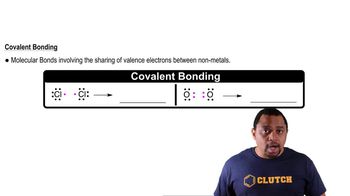
Ionic bonds involve the transfer of electrons from one atom to another, while covalent bonds involve the sharing of electrons between atoms.
Avanzamenti del tracciato
I pulsanti di controllo sono stati cambiati in modalità "navigazione".
1/5
Video consigliati
VideoThumbView.guidedCourse
01:04
Chemical Bonds Example 3
6216
views
55
rank
VideoThumbView.guidedCourse
02:03
Chemical Bonds
7088
views
86
rank
2
comments
VideoThumbView.guidedCourse
01:18
Chemical Bonds Example 2
11616
views
104
rank
1
comments
Termini in questo insieme (5)
Nascondere definizioni
Primary difference between ionic and covalent bonds
Ionic bonds involve the transfer of electrons from one atom to another, while covalent bonds involve the sharing of electrons between atoms.
Atomic number of an element with 11 protons
The atomic number is 11, which equals the number of protons.
Mass number of an element with 11 protons and 12 neutrons
The mass number is 23, calculated as protons (11) plus neutrons (12).
Why do noble gases rarely form chemical bonds?
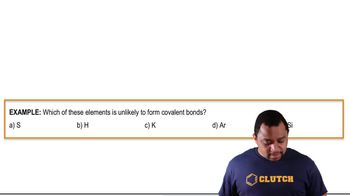
Noble gases have a full valence electron shell, making them chemically stable and unlikely to form bonds.
Balanced chemical equation for hydrogen and oxygen forming water
The balanced equation is \(2H_2 + O_2 \rightarrow 2H_2O\).
 IndietroIndietro
 01:04
01:04