 Indietro
General Chemistry Basics: Matter, Properties, and Classification
 01:34
01:34

Termini in questo insieme (21)
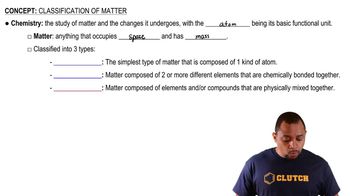
Chemistry is the study of matter—what it consists of, its properties, and how it changes.
Matter is anything that has mass and takes up space, meaning anything physically real.
An organized procedure for learning answers to questions by observing, testing, and generating explanatory models.
Characteristics that describe matter without changing its chemical composition.
Characteristics that describe how matter changes its chemical structure or composition.
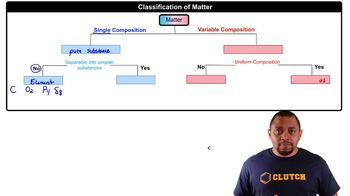
A sample of matter with the same physical and chemical properties throughout.
A substance that cannot be broken down into chemically simpler components.
A substance that can be broken down into chemically simpler components because it contains more than one element.
The smallest part of an element that maintains the identity of that element.
The smallest part of a compound that maintains the identity of that compound.
A material composed of two or more substances.
Heterogeneous mixtures have visibly different parts; homogeneous mixtures have a consistent composition throughout (solutions).
Solids have definite shape and volume; liquids have definite volume but no definite shape; gases have neither definite shape nor volume and expand to fill containers.
A physical process where a substance changes from one phase to another.
Melting or fusion.
Sublimation.
Boiling or evaporation.
Solidification or freezing.
Condensation.
Deposition.
An amount of something expressed as a number and a unit.