 Indietro
General Chemistry: ch 1 and 2
 01:34
01:34

Termini in questo insieme (26)
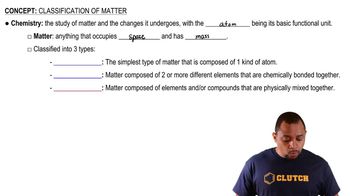
Chemistry is the study of matter, which is anything with mass that occupies space.
An atom is the smallest building block of matter. A molecule is two or more atoms joined together.
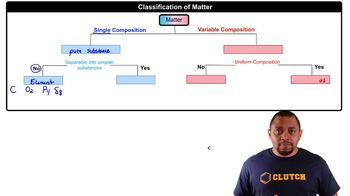
A pure compound always has the same elemental composition and properties regardless of its source.
Physical properties are observed without changing identity (e.g., color, density). Chemical properties describe how a substance reacts (e.g., flammability).
Intensive properties do not depend on sample size (e.g., density). Extensive properties depend on amount (e.g., mass, volume).
Kinetic energy is energy of motion, \(KE=\frac{1}{2}mv^2\). Potential energy is stored energy, such as chemical or gravitational energy.
Length: meter (m); Mass: kilogram (kg); Temperature: kelvin (K); Amount: mole (mol).
\(K=^{\circ}C+273.15\)
Density = mass/volume. Common units: g/mL, g/cm³, g/L.
Add/subtract: answer has fewest decimal places. Multiply/divide: answer has fewest significant figures.
(1) Elements consist of atoms; (2) atoms of an element are identical; (3) atoms are not created/destroyed in reactions; (4) compounds have fixed ratios of atoms.
Most of the atom is empty space; mass and positive charge are concentrated in a tiny, dense nucleus.
Atomic number (Z) = number of protons; Mass number (A) = protons + neutrons.
Neutrons = mass number (A) − atomic number (Z).
Atoms of the same element with the same number of protons but different numbers of neutrons.
Atomic weight = Σ(isotope mass × fractional abundance).
Elements that naturally occur as molecules of two atoms: H₂, N₂, O₂, F₂, Cl₂, Br₂, I₂.
Molecular formula shows actual number of atoms (e.g., H₂O₂). Empirical formula shows simplest whole-number ratio (e.g., HO).
Cation: positive ion formed by losing electrons (usually metals). Anion: negative ion formed by gaining electrons (usually nonmetals).
Name the cation first, then the anion. Use Roman numerals for transition metal charges (e.g., iron(III) chloride).
Monatomic anions end with -ide (e.g., oxide). Oxyanions: -ate is common, -ite has one fewer oxygen; per- means one more oxygen; hypo- means one fewer than -ite.
-ide → hydro___ic acid; -ate → -ic acid; -ite → -ous acid (e.g., HCl hydrochloric acid, HNO₃ nitric acid).
Indicate number of atoms: 1-mono, 2-di, 3-tri, 4-tetra, 5-penta, 6-hexa, 7-hepta, 8-octa, 9-nona, 10-deca.
Hydrocarbons with only single bonds; each carbon bonded to four atoms; names end in -ane (e.g., methane, ethane).
Compounds with the same molecular formula but different arrangements of atoms.
Replace an H with an OH group; name ends in -ol with a number indicating the carbon attached to OH.