 Indietro
General Chemistry Chapter 1 & E Study Flashcards
 01:09
01:09
Termini in questo insieme (26)
Accuracy refers to how close measurements are to the true value, while precision refers to how close measurements are to each other.
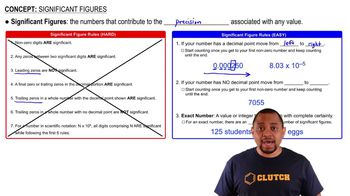
3.04 cm has 3 significant figures because all nonzero digits and zeros between them count.
Write as \(7.60\times10^{6}\) kg to show three significant figures.
1 cm³ = 1 mL, so volume in cubic centimeters equals volume in milliliters.
1 dm³ = 1 L, so volume in cubic decimeters equals volume in liters.
Intensive properties do not depend on amount (e.g., density, color). Extensive properties depend on amount (e.g., mass, volume, length).
Use conversion factors with units to cancel and convert quantities step-by-step, always including units throughout.
The number of protons equals the atomic number of the element from the periodic table.
Neutrons = mass number - atomic number.
Cations are positively charged ions; anions are negatively charged ions.
Average atomic mass = sum of (isotope mass × fractional abundance) for all isotopes.
Use molar mass as a conversion factor: \(\text{grams} = \text{moles} \times \text{molar mass}\\).
Convert grams to moles using molar mass, then moles to atoms using Avogadro's number.
Charge = number of protons - number of electrons.
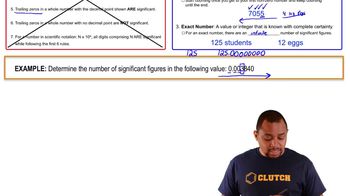
5200 m has 2 significant figures if no decimal is shown; trailing zeros without a decimal are not significant.
Result should be rounded to the least number of decimal places among the numbers added.
Result should be rounded to the least number of significant figures among the numbers multiplied.
Density = mass / volume, often expressed in g/mL or g/cm³.
Multiply by 1000: \(3.4\,\text{L} \times 1000 = 3400\,\text{mL}\).
Calculate volume in cubic feet, convert to cubic meters, then to liters (1 m³ = 1000 L).
Convert miles to kilometers and gallons to liters using conversion factors, then divide.
Mg atomic number is 12, Mg2+ has lost 2 electrons, so electrons = 10.
Convert atoms to moles using Avogadro's number, then moles to grams using molar mass.
Measurements are close to each other but far from the true value.
It has 4 significant figures because all digits including zeros after decimal count.
Mass = volume × density; convert units as needed.