 Indietro
General Chemistry: Chemical Reactions and Stoichiometry
 01:20
01:20
Termini in questo insieme (23)
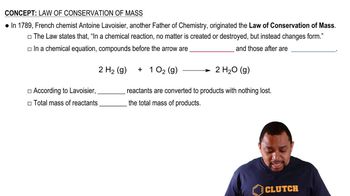
Stoichiometry is the study of the quantities of substances consumed and produced in chemical reactions, based on the Law of Conservation of Mass.
A chemical equation represents a chemical reaction, showing reactants on the left and products on the right, separated by an arrow.
Balance equations by changing coefficients, not subscripts, to obey the Law of Conservation of Mass, ensuring equal atoms of each element on both sides.
They indicate states of matter: (g) gas, (l) liquid, (s) solid, and (aq) aqueous (dissolved in water).
Δ means heat is required for the reaction to occur.
A combination reaction occurs when two or more reactants combine to form a single product.
A decomposition reaction is when one substance breaks down into two or more substances, often upon heating.
Metal carbonates decompose to form a metal oxide and carbon dioxide gas.
Combustion reactions are rapid, produce a flame, and usually involve oxygen as a reactant.
Combustion of hydrocarbons produces carbon dioxide (CO2) and water (H2O).
Formula weight is the sum of atomic weights of atoms in a compound's empirical formula.
Molecular weight is the sum of atomic weights of atoms in a molecule; it equals formula weight for molecules.
Percent composition = (mass of element in formula / formula weight) × 100%
Avogadro's number is \(6.02\times10^{23}\), the number of particles in one mole.
Molar mass is the mass of 1 mole of a substance, expressed in grams per mole (g/mol), numerically equal to atomic or molecular weight in amu.
Mole relationships use coefficients from balanced equations to convert between moles of reactants and products.
Divide the mass in grams by the molar mass (g/mol) of the substance.
Convert percent to grams, grams to moles, divide by smallest mole value, and use ratios as subscripts.
Divide the molar mass by the empirical formula mass to find a whole number multiple, then multiply subscripts by this number.
Combustion analysis determines the amounts of C, H, and O in a compound by measuring CO2 and H2O produced.
The limiting reactant is the reactant that is completely consumed first, limiting the amount of product formed.
The theoretical yield is the maximum amount of product predicted by stoichiometric calculations.
Percent yield = (actual yield / theoretical yield) × 100%