 Indietro
General Chemistry: Chemistry and Measurements
 01:34
01:34

Termini in questo insieme (22)
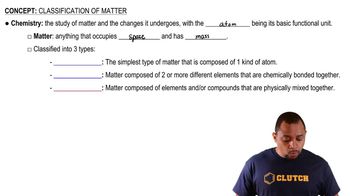
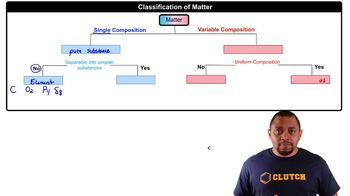
Matter is anything that has mass and volume.
A chemical is a substance that always has the same composition and properties wherever found.
1. Observation
2. Hypothesis
3. Experiment
4. Model (Theory)
5. Further Experiment
Qualitative analysis studies properties like color, smell, texture.
Quantitative analysis involves measurements like mass, length, volume, temperature.
SI units are the revised metric system accepted worldwide, consisting of seven base units and many derived units.
Mass: kilogram (kg)
Length: meter (m)
Time: second (s)
Temperature: Kelvin (K)
Amount of substance: mole (mol)
Electric current: ampere (A)
Luminous intensity: candela (cd)
Area: square meter (m\(2\))
Volume: cubic meter (m\(3\))
Density: kg/m\(3\)
Velocity: m/s
A way to express very large or very small numbers as a decimal part times 10 raised to an exponent, e.g., 1.2345 × 10\(4\).
The decimal part must be ≥ 1 and < 10; the exponent is adjusted accordingly.
Prefixes to simplify large or small numbers, e.g., kilo (k) = 10\(3\), milli (m) = 10\(-3\), micro (μ) = 10\(-6\).
Significant figures include all certain digits plus one estimated digit; leading zeros are not significant, trailing zeros right of decimal are significant.
Trailing zeros left of decimal with a decimal point count as significant; without decimal point, they do not.
The result should be rounded to the least number of decimal places of any number in the operation.
The result should have the same number of significant figures as the number with the fewest significant figures.
A method to convert units by multiplying by conversion factors that cancel units systematically.
Multiply the quantity by a fraction equal to one, where numerator and denominator are equivalent quantities in different units.
24 eggs × (1 dozen / 12 eggs) = 2 dozen
Cube the conversion factor for length units, e.g., 1 m = 3.28 ft implies 1 m\(3\) = 35.3 ft\(3\).
Density is mass divided by volume: \(d=\frac{m}{V}\).
Because mineral oil has a lower density than water, it floats on top in a gravitational field.
Specific gravity is the ratio of the density of a sample to the density of water; it is dimensionless.
Percent = (part/whole) × 100
ppm = (part/whole) × 10\(6\)
ppb = (part/whole) × 10\(9\)