 Indietro
General Chemistry: Electron Basics
 02:15
02:15
Termini in questo insieme (20)
An electron is a subatomic particle with a negative electric charge found outside the nucleus of an atom.
An electron has a charge of \(-1.602 \times 10^{-19}\\) coulombs.
Electrons are located in the electron cloud surrounding the nucleus, occupying atomic orbitals.
The mass of an electron is about \(9.11 \times 10^{-31}\\) kilograms, much smaller than protons or neutrons.
Chemical properties depend mainly on the arrangement and number of valence electrons in the outermost shell.
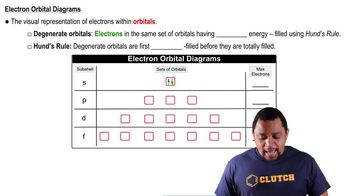
An atomic orbital is a region around the nucleus where there is a high probability of finding an electron.
It states that no two electrons in an atom can have the same set of four quantum numbers.
Electron spin is a quantum property that can have values of +1/2 or -1/2, representing two possible spin states.
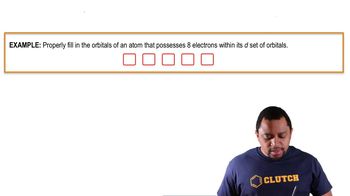
Each atomic orbital can hold a maximum of two electrons with opposite spins.
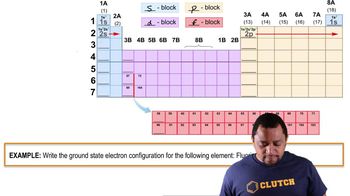
Electron configuration describes the distribution of electrons in an atom's orbitals and determines its chemical behavior.
An ion is an atom or molecule that has gained or lost electrons, resulting in a net electric charge.
Electrons are shared or transferred between atoms to form covalent or ionic bonds.
Core electrons are inner electrons not involved in bonding; valence electrons are outer electrons involved in chemical reactions.
The photoelectric effect is the emission of electrons from a material when light shines on it.
Electric current is the flow of electrons through a conductor.
An electron volt is the energy gained by an electron when accelerated through a potential difference of one volt.
Electrons exhibit both particle and wave properties, described by quantum mechanics.
It states that the exact position and momentum of an electron cannot be simultaneously known.
The electron cloud model represents the probable locations of electrons around the nucleus.
Electrons absorb and emit energy in discrete amounts, producing characteristic atomic spectra.