 Indietro
General Chemistry: Matter and Energy
 01:26
01:26
Termini in questo insieme (29)
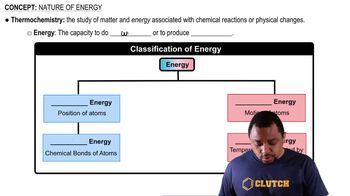
Energy is the capacity for performing work.
Potential energy (PE), kinetic energy (KE), and thermal energy (heat).
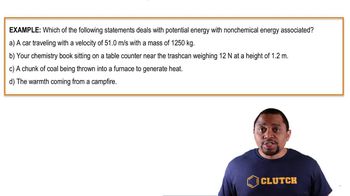
Energy an object has due to its position or arrangement of parts, such as in a gravitational field.
Energy associated with motion, proportional to mass and the square of velocity: \(KE=\frac{1}{2}mv^2\).
Energy can neither be created nor destroyed; it only transfers or transforms.
Sum of microscopic kinetic energy of particles in matter; related to temperature.
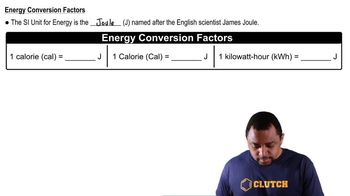
SI unit: Joule (J); traditional unit: calorie (cal); 1 cal = 4.184 J exactly.
\(T(K)=T(^\circ C)+273.15\)
Matter is anything that has mass and volume.
Heterogeneous mixtures have visible boundaries and varying composition; homogeneous mixtures (solutions) have uniform composition throughout.
Substances consisting of a single type of chemical, either elements or compounds.
Elements cannot be broken down by chemical means; compounds can be broken into two or more elements.
Properties a substance has by itself without interaction with other substances.
Solid, liquid, and gas.
Particles have high thermal energy and make little contact with each other.
Particles have enough thermal energy to move around but remain close.
Particles are fixed in a crystal lattice but vibrate around equilibrium positions.
A change involving only one substance without chemical interaction, usually reversible (e.g., phase changes).
A property observed when a substance interacts or transforms into other substances.
A change involving interaction between substances, often irreversible, producing new substances.
The proportional constant relating heat added to temperature change: \(Heat=mass \times \Delta T \times SH\).
Heat flows into the system; heat is positive.
Heat flows out of the system; heat is negative.
Electrons (negative charge), protons (positive charge), and neutrons (neutral).
The number of protons and electrons; neutrons do not affect chemical properties.
The number of protons in an atom.
The total number of protons and neutrons in an atom.
Atoms of the same element with different numbers of neutrons.
Opposite charges attract; like charges repel.