 Indietro
General Chemistry: Matter, Measurement, and Problem Solving
 01:34
01:34

Termini in questo insieme (20)
Atoms are the basic units of matter, and molecules are groups of atoms bonded together.
The scientific approach involves making observations, forming hypotheses, conducting experiments, and developing theories.
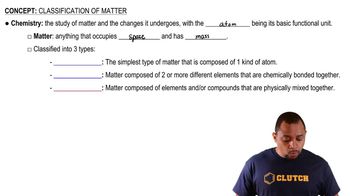
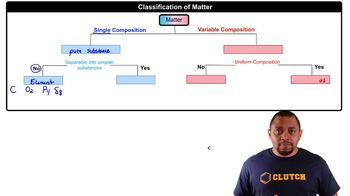
Matter is classified as pure substances (elements and compounds) or mixtures (homogeneous and heterogeneous).
The three common states of matter are solid, liquid, and gas, each with distinct properties.
Physical changes alter appearance without changing composition; chemical changes produce new substances.
Physical properties can be observed without changing composition; chemical properties describe how a substance reacts.
The SI system is the international metric system used for scientific measurements, based on units like meter, kilogram, and second.
Metric units are based on powers of ten; English units are traditional units like inches and pounds.
Scientific notation expresses very large or small numbers as a product of a number between 1 and 10 and a power of ten.
Significant figures indicate the precision of a measurement, including all known digits plus one estimated digit.
Use \(K = ^\circ C + 273.15\) to convert Celsius to Kelvin.
Use \(^\circ F = \frac{9}{5}(^\circ C) + 32\) to convert Celsius to Fahrenheit.
Density is mass divided by volume: \(\text{density} = \frac{\text{mass}}{\text{volume}}\).
Precision refers to reproducibility of measurements; accuracy refers to closeness to the true value.
Dimensional analysis is a problem-solving method using conversion factors to change units systematically.
It ensures units are consistent and correct in calculations, preventing errors in chemical problem solving.
Examples include color, melting point, boiling point, density, and state of matter.
Examples include flammability, reactivity with acids, and oxidation states.
A pure substance has a fixed composition and distinct properties, such as elements and compounds.
A mixture contains two or more substances physically combined, which can be separated by physical means.