The properties of matter are determined by the properties of molecules and atoms.
What are atoms and molecules in relation to matter?
Atoms are submicroscopic particles that are the fundamental building blocks of matter; molecules are groups of atoms bonded in specific arrangements.
How do graphite and diamond differ despite both being carbon?
Graphite atoms are arranged in sheets, while diamond atoms form a three-dimensional structure, leading to different properties.
What is the scientific method?
A process for understanding nature by observation, hypothesis formulation, experimentation, and development of laws and theories.
Define a scientific hypothesis.
A tentative explanation of observations that is falsifiable and can be tested by experiments.
What is a scientific law?
A brief statement summarizing past observations and predicting future ones, such as the law of conservation of mass.
What is a scientific theory?
A well-established model explaining why nature behaves as it does, validated by experiments but never conclusively proven.
How is matter classified by state?
Matter exists as solid, liquid, or gas, distinguished by particle arrangement and movement.
Describe the characteristics of solid matter.
Atoms or molecules are closely packed in fixed locations, vibrating but not moving past each other, giving solids fixed volume and shape.
What distinguishes crystalline solids from amorphous solids?
Crystalline solids have long-range repeating atomic order; amorphous solids lack this order.
Describe liquid matter properties.
Particles are close but free to move relative to each other; liquids have fixed volume but take the shape of their container.
What are the properties of gaseous matter?
Particles have large spaces between them, move freely, and gases are compressible.
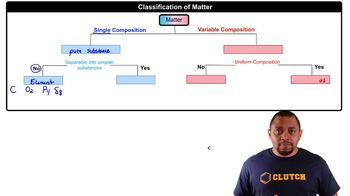
How is matter classified by composition?
Matter is classified as pure substances (elements or compounds) or mixtures (heterogeneous or homogeneous).
Define an element and a compound.
An element cannot be chemically broken down; a compound consists of two or more elements in fixed proportions.
What is the difference between heterogeneous and homogeneous mixtures?
Heterogeneous mixtures have variable composition in different regions; homogeneous mixtures have uniform composition throughout.
Name three methods to separate mixtures.
Decanting, distillation, and filtration exploit physical or chemical property differences to separate mixture components.
What is a physical change?
A change altering only the state or appearance of a substance without changing its composition.
What is a chemical change?
A change that alters the composition of matter by rearranging atoms to form new substances.
Differentiate physical and chemical properties.
Physical properties can be observed without changing composition; chemical properties require a chemical change to be observed.
What is energy in chemistry?
The capacity to do work, including kinetic energy (motion), potential energy (position/composition), and thermal energy (temperature-related kinetic energy).
State the law of conservation of energy.
Energy is neither created nor destroyed in physical or chemical changes.
What is the SI unit of length and how is it defined?
The meter (m), defined as the distance light travels in a vacuum in 1/299,792,458 of a second.
What is the SI unit of mass?
The kilogram (kg), which is 1000 grams; mass measures the quantity of matter.
How is temperature measured in SI units?
Temperature is measured in kelvin (K), an absolute scale where 0 K is absolute zero.
What are SI prefix multipliers?
Prefixes that change unit values by powers of ten, such as kilo (10^3), milli (10^-3), and micro (10^-6).
Define density and its units.
Density is mass per unit volume, typically expressed in grams per cubic centimeter (g/cm³).
What is the difference between intensive and extensive properties?
Intensive properties do not depend on amount (e.g., density); extensive properties depend on amount (e.g., mass).
What are significant figures?
Digits in a measurement that reflect its precision, including all certain digits plus one estimated digit.
Rules for counting significant figures?
All nonzero digits and interior zeros are significant; leading zeros are not; trailing zeros depend on decimal placement.
How to apply significant figures in multiplication/division?
Result carries the same number of significant figures as the factor with the fewest significant figures.
How to apply significant figures in addition/subtraction?
Result carries the same number of decimal places as the quantity with the fewest decimal places.
Difference between accuracy and precision?
Accuracy is closeness to the true value; precision is consistency among repeated measurements.
What is dimensional analysis?
A problem-solving method using units to guide calculations and conversions.
 Indietro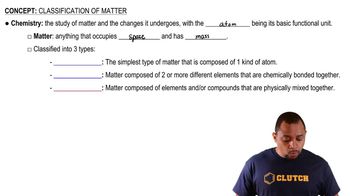
 01:34
01:34