 Indietro
General Chemistry: Matter, Measurement & Problem Solving
 01:34
01:34

Termini in questo insieme (20)
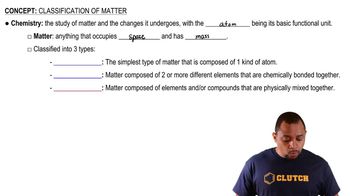
Matter is anything that occupies space and has mass.
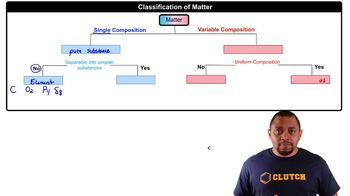
Elements (one kind of atom), compounds (two or more different elements chemically bonded), and mixtures (physically mixed elements and/or compounds).
A change in the physical state of a substance without changing its composition.
A change that alters the chemical composition, creating new chemical bonds and products.
A change that can be undone to restore the original structure, such as phase changes or dissolving.
A permanent change that cannot be undone, such as burning or cooking.
A property observed during a chemical reaction where the matter changes into a new substance.
A measurable property describing the state of a substance, observable without changing its chemical structure.
Properties that do not depend on the amount of substance, such as melting point and density.
Properties that depend on the amount of substance, such as mass and volume.
Temperature is the average kinetic energy of an object, a measure of thermal energy.
Heat is the transfer of thermal energy from a higher temperature object to a lower temperature object.
Degrees Celsius (ºC), Fahrenheit (ºF), and Kelvin (K).
A method to express very large or small numbers as a coefficient between 1 and 10 multiplied by 10 raised to an exponent.
Mass: kilogram (kg), Length: meter (m), Time: second (s).
Volume = length × width × height
Density is the amount of mass per unit volume, usually g/cm³ for solids and liquids.
By water displacement: the volume of water displaced equals the volume of the object.
The result should have the same number of significant figures as the factor with the least significant figures.
The result should have the same number of decimal places as the number with the least decimal places.