 Indietro
General Chemistry: Measurement, Properties, and Separation Techniques
 01:09
01:09
Termini in questo insieme (24)
Accuracy is how close a measured value is to the true or accepted value.
Precision is how reproducible or consistent repeated measurements are, regardless of closeness to the true value.
Accuracy measures closeness to true value; precision measures consistency of repeated measurements.
Record all certain digits plus one estimated digit; the last digit is uncertain and reflects measurement precision.
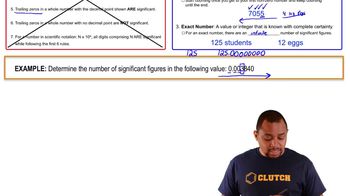
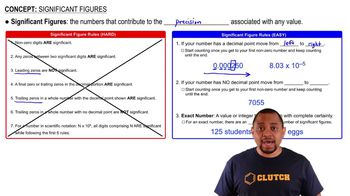
Significant figures indicate the precision of a measured value based on counting rules related to zeros and decimal points.
Count digits from left to right starting at the first nonzero digit when a decimal point is present.
Count digits from right to left starting at the first nonzero digit when no decimal point is present.
Exact counted values (e.g., 12 eggs) have an infinite number of significant figures.
The number 0.00450 has three significant figures: 4, 5, and the trailing 0.
Result should have as many significant figures as the value with the fewest significant figures.
Result should have as many decimal places as the value with the fewest decimal places.
Mass: kilogram (kg), Length: meter (m), Time: second (s), Temperature: kelvin (K), Amount: mole (mol), Electric current: ampere (A), Luminous intensity: candela (cd).
Method for converting units using conversion factors so unwanted units cancel, leaving the desired unit.
Analytical, Biochemistry, Inorganic, Organic, and Physical Chemistry.
Pure science builds knowledge for its own sake; applied science uses knowledge to solve practical problems.
Properties that do not depend on the amount of substance, e.g., color, density, boiling point, temperature.
Properties that depend on the amount of substance, e.g., mass, volume, length, energy.
Mixtures with uniform composition throughout, e.g., air, saltwater.
Mixtures with non-uniform composition, e.g., oil and water, salad.
Separation technique using a porous barrier to separate solids from liquids, e.g., sand from water.
Removes liquid from a solution to recover dissolved solids, e.g., salt from saltwater.
Separates substances based on differences in boiling points, e.g., separating alcohol from water.
Separates components based on solubility in different immiscible liquids, e.g., separating oil from water.
Add water to dissolve salt, filter to remove sand, then evaporate water to recover salt.