 Indietro
General Chemistry: Polyatomic Ions, Periodic Table Charges, Oxidation Numbers, and Solubility Rules
 01:16
01:16
Termini in questo insieme (20)
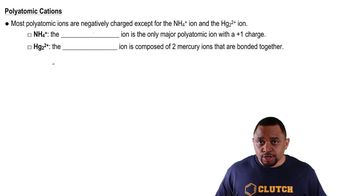
A polyatomic ion is a charged species composed of two or more atoms covalently bonded that act as a single ion.
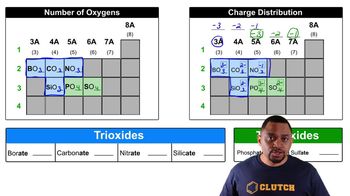
Nitrate ion is \(NO_3^-\) with a charge of -1.
Sulfate ion is \(SO_4^{2-}\) with a charge of -2.
Ammonium ion is \(NH_4^+\) with a charge of +1.
Alkali metals (Group 1) have a charge of +1 when forming ions.
Alkaline earth metals (Group 2) have a charge of +2 when forming ions.
Halogens (Group 17) typically have a charge of -1 when forming ions.
Oxygen usually has an oxidation number of -2 in compounds.
The oxidation number of any free element is 0.
The oxidation number of a monoatomic ion equals its charge.
The sum of oxidation numbers in a neutral compound is 0.
The sum of oxidation numbers in a polyatomic ion equals the charge of the ion.
Hydrogen usually has an oxidation number of +1 when bonded to nonmetals.
When bonded to metals, hydrogen has an oxidation number of -1.
All nitrate (NO3-) salts are soluble in water.
Salts of alkali metals (Group 1) are soluble in water.
Most halide (Cl-, Br-, I-) salts are soluble except those of Ag+, Pb2+, and Hg2+.
Most sulfate (SO4 2-) salts are soluble except those of Ba2+, Pb2+, Hg2+, and Ca2+.
Most hydroxides (OH-) are insoluble except those of alkali metals and Ba2+.
Most carbonates (CO3 2-) and phosphates (PO4 3-) are insoluble except those of alkali metals and ammonium.