Skip to main content
General Chemistry
Il mio corso
Impara
Preparazione agli esami
AI Tutor
Guide di studio
Soluzioni per libri di testo
Flashcard
Esplora
Prova l'app
Il mio corso
Impara
Preparazione agli esami
AI Tutor
Guide di studio
Soluzioni per libri di testo
Flashcard
Esplora
Prova l'app
Indietro
General Chemistry: Quantum Theory and Electron Configuration
Puoi toccare per girare la carta.
What is the wave-particle duality?
Puoi toccare per girare la carta.
👆
What is the wave-particle duality?
The concept that particles like electrons exhibit both wave and particle properties, as described by De Broglie and Einstein.
Avanzamenti del tracciato
I pulsanti di controllo sono stati cambiati in modalità "navigazione".
1/20
Video consigliati
VideoThumbView.guidedCourse
00:58
De Broglie Wavelength Formula
6201
views
47
rank
VideoThumbView.guidedCourse
01:39
De Broglie Wavelength Example
4624
views
39
rank
2
comments
Termini in questo insieme (20)
Nascondere definizioni
What is the wave-particle duality?
The concept that particles like electrons exhibit both wave and particle properties, as described by De Broglie and Einstein.
State De Broglie's hypothesis.
Particles have a wavelength given by \(\lambda=\frac{h}{p}\), where
h
is Planck's constant and
p
is momentum.
What does Heisenberg's uncertainty principle state?
It is impossible to simultaneously know both the exact position and momentum of a particle with perfect accuracy.
What is Schrödinger's wave function?
A mathematical function that describes the probability amplitude of an electron's position and energy in an atom.
What do quantum numbers represent?
They specify the properties of atomic orbitals and the properties of electrons in those orbitals.
List the four quantum numbers.
n
(principal),
l
(azimuthal),
m_l
(magnetic), and
m_s
(spin).
What is Pauli's exclusion principle?
No two electrons in an atom can have the same set of all four quantum numbers.
Explain the Aufbau principle.
Electrons fill atomic orbitals starting with the lowest energy levels before filling higher levels.
How is electron configuration written?
By listing orbitals in order of increasing energy with superscripts indicating the number of electrons, e.g., 1s² 2s² 2p⁶.
What causes periodicity in the periodic table?
The repeating pattern of chemical properties due to electron configurations and effective nuclear charge.
How do electron repulsion and intercharge affect electron arrangement?
Electrons repel each other, influencing orbital shapes and energy levels to minimize repulsion.
Describe the shape of s orbitals.
Spherical shape centered around the nucleus.
Describe the shape of p orbitals.
Dumbbell-shaped with two lobes on opposite sides of the nucleus.
What is the significance of the magnetic quantum number
m_l
?
It indicates the orientation of an orbital within a subshell.
What does the spin quantum number
m_s
represent?
The intrinsic spin of an electron, which can be +½ or -½.
Why do electrons fill orbitals singly before pairing?
Due to Hund's rule, which minimizes electron repulsion by maximizing unpaired electrons in degenerate orbitals.
What is the relationship between energy levels and principal quantum number
n
?
Energy increases as
n
increases; higher
n
means electrons are farther from the nucleus.
How does effective nuclear charge affect electron configuration?
It influences the attraction between electrons and the nucleus, affecting orbital energies and electron arrangement.
What is the role of electron configuration in chemical properties?
It determines an element's reactivity, bonding behavior, and placement in the periodic table.
Explain the concept of orbital hybridization briefly.
The mixing of atomic orbitals to form new hybrid orbitals suitable for bonding.
 IndietroIndietro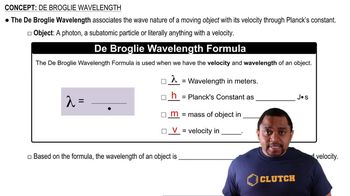
 00:58
00:58