Skip to main content
General Chemistry
Il mio corso
Impara
Preparazione agli esami
AI Tutor
Guide di studio
Soluzioni per libri di testo
Flashcard
Esplora
Prova l'app
Il mio corso
Impara
Preparazione agli esami
AI Tutor
Guide di studio
Soluzioni per libri di testo
Flashcard
Esplora
Prova l'app
Indietro
General Chemistry Review
Puoi toccare per girare la carta.
What is the difference between a physical change and a chemical change?
Puoi toccare per girare la carta.
👆
What is the difference between a physical change and a chemical change?
Physical change
alters the form or appearance but not the composition.
Chemical change
results in new substances with different compositions.
Avanzamenti del tracciato
I pulsanti di controllo sono stati cambiati in modalità "navigazione".
1/20
Video consigliati
VideoThumbView.guidedCourse
01:34
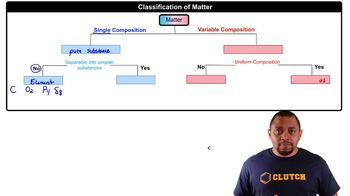
Types of Matter
51985
views
1704
rank
13
comments
VideoThumbView.guidedCourse
1:44
Introduction to General Chemistry Course
51760
views
932
rank
14
comments
VideoThumbView.guidedCourse
04:19
Matter Composition
37175
views
932
rank
10
comments
Termini in questo insieme (20)
Nascondere definizioni
What is the difference between a physical change and a chemical change?
Physical change
alters the form or appearance but not the composition.
Chemical change
results in new substances with different compositions.
What are the three states of matter shown in the diagrams?
Solid
,
liquid
, and
gas
.
What is the law of conservation of mass?
Mass is neither created nor destroyed in a chemical reaction; total mass of reactants equals total mass of products.
What is an atom?
The smallest unit of an element that retains the chemical properties of that element.
What is the difference between an element and a compound?
An
element
consists of one type of atom; a
compound
consists of two or more elements chemically combined.
What is a mixture?
A physical combination of two or more substances where each retains its own properties.
What is the difference between homogeneous and heterogeneous mixtures?
Homogeneous mixtures
have uniform composition;
heterogeneous mixtures
have visibly different parts.
What is the significance of the periodic table?
It organizes elements by increasing atomic number and groups with similar properties.
What is an isotope?
Atoms of the same element with different numbers of neutrons.
What is atomic number?
The number of protons in an atom's nucleus.
What is mass number?
The total number of protons and neutrons in an atom's nucleus.
What is the difference between ionic and covalent bonds?
Ionic bonds
form by transfer of electrons;
covalent bonds
form by sharing electrons.
What is a molecule?
Two or more atoms chemically bonded together.
What is the octet rule?
Atoms tend to gain, lose, or share electrons to have eight electrons in their valence shell.
What is a chemical formula?
A notation showing the types and numbers of atoms in a compound.
What is the difference between empirical and molecular formulas?
Empirical formula shows the simplest ratio of atoms; molecular formula shows the actual number of atoms.
What is molar mass?
The mass of one mole of a substance, usually in grams per mole.
What is Avogadro's number?
The number of particles in one mole, approximately \(6.022 \times 10^{23}\).
What is the difference between accuracy and precision?
Accuracy
is how close a measurement is to the true value;
precision
is how close repeated measurements are to each other.
What is the difference between a solute and a solvent?
The
solute
is the substance dissolved; the
solvent
is the substance doing the dissolving.
 IndietroIndietro
 01:34
01:34