 Indietro
General Chemistry: The Atom
 02:53
02:53
Termini in questo insieme (20)
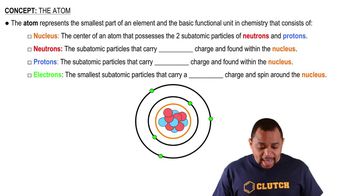
An atom is the smallest unit of an element that retains the chemical properties of that element.
Protons, neutrons, and electrons.
Protons are located in the nucleus at the center of the atom.
A proton has a positive charge (+1).
Neutrons are found in the nucleus alongside protons.
A neutron has no charge (neutral).
Electrons orbit the nucleus in the electron cloud.
An electron has a negative charge (-1).
The number of protons in the nucleus.
Atoms of the same element with the same number of protons but different numbers of neutrons.
They have different mass numbers due to varying neutrons but the same chemical properties.
The total number of protons and neutrons in the nucleus.
It is the weighted average of the masses of all naturally occurring isotopes.
Zero, because the number of protons equals the number of electrons.
An atom or molecule with a net electric charge due to loss or gain of electrons.
A positively charged ion formed by losing electrons.
A negatively charged ion formed by gaining electrons.
Electrons in the outermost shell (valence electrons) participate in forming chemical bonds.
The dense central core containing protons and neutrons.
The number and arrangement of electrons determine an atom's chemical behavior.