 Indietro
General Chemistry: Thermochemistry Key Concepts
 01:26
01:26

Termini in questo insieme (27)
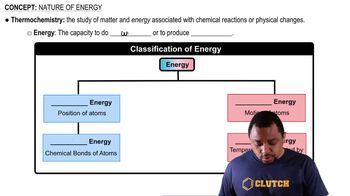
Energy is the ability to do work or transfer heat.
Thermochemistry is the study of chemical reactions and the energy changes that involve heat.
Electrostatic potential energy (Eel) is the most important form of potential energy in molecules.
Energy is released when bonds form and consumed when bonds break.
Energy can be converted from one form to another but is neither created nor destroyed.
The system is the portion of the universe studied; the surroundings are everything else.
Open system: exchanges heat and mass; Closed system: exchanges heat only; Isolated system: exchanges neither heat nor mass.
Internal energy is the sum of all kinetic and potential energies of the system's components.
ΔE = Efinal − Einitial, the difference between final and initial internal energy.
Energy is exchanged as heat (q) or work (w).
Positive when energy enters the system; negative when energy leaves the system.
An endothermic process absorbs heat from the surroundings (q > 0).
An exothermic process releases heat to the surroundings (q < 0).
A state function depends only on the current state, not the path taken. Internal energy (E) is a state function.
No, heat and work depend on the path and are not state functions.
Work done by gas expansion or compression: \(w = -P\Delta V\).
Enthalpy is the internal energy plus the product of pressure and volume: \(H = E + PV\).
At constant pressure, ΔH equals the heat absorbed or released by the system.
ΔH for a reaction carried out in steps equals the sum of ΔH for each step; enthalpy is a state function.
ΔHf is the enthalpy change when one mole of a compound forms from its elements in their standard states.
ΔH ≈ sum of bond enthalpies of bonds broken minus bonds formed.
Bond enthalpy is always positive because energy is required to break bonds.
Calorimetry is the measurement of heat flow during chemical reactions or physical changes.
The energy required to raise the temperature of 1 gram of a substance by 1 K (or °C).
Water's specific heat is 4.184 J/g·K, commonly used for dilute aqueous solutions.
Bomb calorimetry measures ΔE at constant volume; constant pressure calorimetry measures ΔH.
Petroleum, natural gas, coal, nuclear, and renewable energy sources.