 Indietro
General Chemistry: Units, Measurements, and Problem Solving
 02:13
02:13
Termini in questo insieme (20)
Qualitative observations are descriptive, such as changes in color or physical state. Quantitative observations involve numerical measurements or counts, like number of cats per household.
All measurements consist of a number reflecting precision and a unit from systems like SI or English.
Systematic errors are consistent and directional (always high or low). Random errors vary unpredictably and are harder to correct.
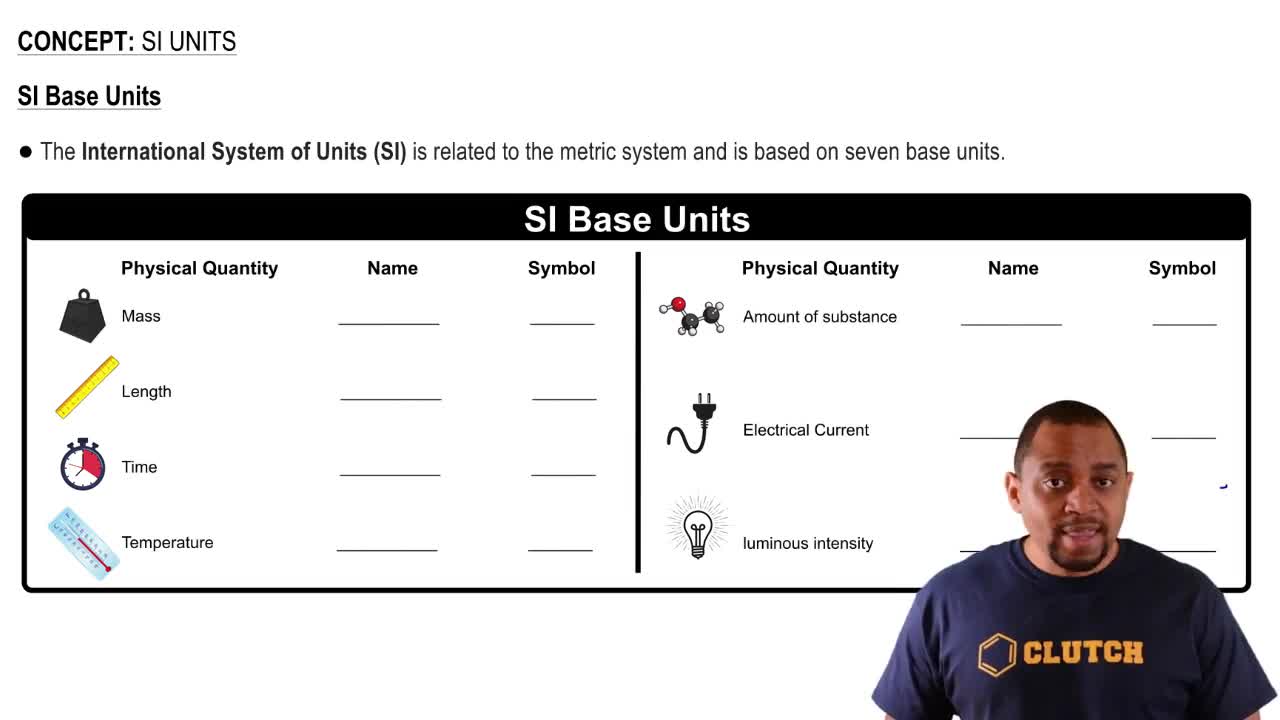
Length: meter (m), Mass: kilogram (kg), Time: second (s), Temperature: kelvin (K), Amount of substance: mole (mol), Electric current: ampere (A), Luminous intensity: candela (cd).
Prefixes like kilo (k, 103), milli (m, 10-3), micro (μ, 10-6), and mega (M, 106) scale units by powers of ten.
Fahrenheit, Celsius, and Kelvin scales differ in zero points and increments. Water freezes at 0°C/273 K/32°F and boils at 100°C/373 K/212°F. Kelvin has no negative values.
Use \(K = ^\circ C + 273.15\) to convert Celsius to Kelvin.
Use \(^\circ F = (9/5) \times ^\circ C + 32\) to convert Celsius to Fahrenheit.
All nonzero digits are significant. Example: 536 has three significant figures.
Zeros between nonzero digits are significant; leading zeros are not; trailing zeros after a decimal are significant; trailing zeros without a decimal are ambiguous.
Exact values like conversion factors have infinite significant figures and do not limit precision in calculations.
Precision is the closeness of repeated measurements; accuracy is closeness to the true value. You can be precise without being accurate and vice versa.
For multiplication/division, the result has the same significant figures as the least precise value. For addition/subtraction, the result matches the smallest decimal place.
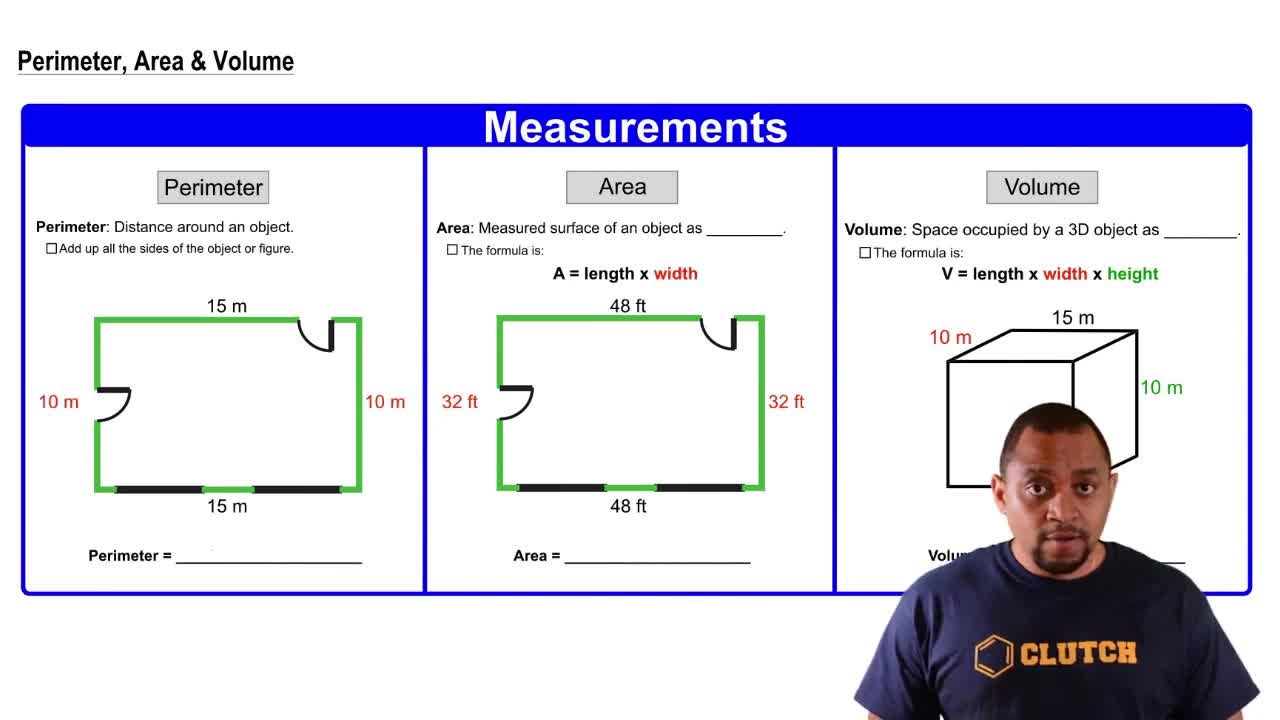
Density is an intensive property defined as mass divided by volume: \(\rho = \frac{m}{V}\).
1 calorie (cal) raises 1 g of water by 1°C and equals 4.184 joules (J). Kilocalorie (kcal) = 1000 cal. Joule is a small energy unit; kilojoule (kJ) = 1000 J.
Energy of the universe is conserved. Energy can be transferred between system and surroundings but total energy remains constant.
Exothermic: system loses heat, energy decreases. Endothermic: system gains heat, energy increases.
Use conversion factors to cancel units stepwise, converting from given units to desired units.
To convert 1.76 yards to centimeters, multiply by conversion factors: \(1.76 \times \frac{1 \text{ meter}}{1.094 \text{ yards}} \times \frac{100 \text{ cm}}{1 \text{ meter}}\).
Read the meniscus at eye level; estimate one digit beyond the smallest marked division for precision.