 Indietro
ochem excersize questions
 01:29
01:29
Termini in questo insieme (50)
what kind of molecules trigger our sense of smell?
x
what is unique about carbon and carbon-based compounds & why did life evolve around carbon?
x
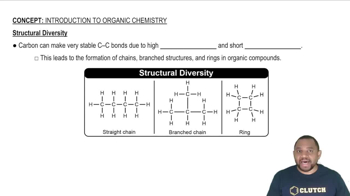
why does carbon form such a large diversity of compounds?
x
why does silicon exhibit less diversity of compounds than carbon?
x
describe the geometry and hybridization about a carbon atom that forms the following:
four single bonds.
two single bonds and one double bond.
one single bond and one triple bond.
x
what are hydrocarbons & their main uses?
x
what are the main classifications of hydrocarbons & their generic molecular formulas?
x
what are the differences between a structural formula, a condensed structural formula, a bond line formula, a ball-and-stick model, and a space-filling model?
x
what are structural isomers & how do the properties of structural isomers differ from one another?
x
what are optical isomers & how do the properties of optical isomers differ from one another?
x
define each term related to optical isomerism: enantiomers, chiral, dextrorotatory, levorotatory, racemic mixture.
x
what is the difference between saturated and unsaturated hydrocarbons?
x
what are the key differences in the way that alkanes, alkenes, and alkynes are named?
x
explain geometric isomerism in alkenes, how do the properties of geometric isomers differ from one another?
x
describe and provide an example of a hydrocarbon combustion reaction.
x
what kinds of reactions are common to alkanes? list an example of each.
x
describe each kind of reaction.
substitution reaction
addition reaction
elimination reaction
x
what kinds of reactions are common to alkenes? list an example of each.
x
explain markovnikov’s rule and give an example of a reaction to which it applies.
x
what kinds of reactions are common to aromatic compounds? list an example of each.
x
what is a functional group? list some examples.
x
what is the generic structure of alcohols?
x
explain oxidation and reduction with respect to organic compounds.
x
which kinds of reactions are common to alcohols? list an example of each.
x
what are the generic structures for aldehydes and ketones?
x
which kinds of reactions are common to aldehydes and ketones? list an example of each.
x
what are the generic structures for carboxylic acids and esters?
x
which kinds of reactions are common to carboxylic acids and esters? list an example of each.
x
what is the generic structure of ethers?
x
what is the generic structure of amines?
x
based on the molecular formula, determine whether each compound is an alkane, alkene, or alkyne. (assume that the hydrocarbons are noncyclical and that there is no more than one multiple bond.)
C₃H₈
C₆H₁₀
C₄H₈
C₁₀H₂₂
C₅H₁₂
C₂H₂
C₇H₁₄
C₁₁H₂₂
x
write structural formulas for each of the nine structural isomers of heptane.
x
write structural formulas for any 6 of the 18 structural isomers of octane.
x
determine whether each compound exhibits optical isomerism.
CCl₄
CCH₃HClNH₂
CH₃CHClCH₃
CH₃CCl₂CH₃
x
name the alkane.
CH₃-CH₂-CH₂-CH₂-CH₃
x
draw a structure for each alkane.
3-ethylhexane
3-ethyl-3-methylpentane
2,3-dimethylbutane
4,7-diethyl-2,2-dimethylnonane
2,2-dimethylpentane
3-isopropylheptane
4-ethyl-2,2-dimethylhexane
4,4-diethyloctane
x
complete and balance each hydrocarbon combustion reaction.
CH₃CH₂CH₃+O₂⟶
CH₃CH₂CH═CH₂+O₂⟶
CH≡CH+O₂⟶
CH₃CH₂CH₂CH₃+O₂⟶
CH₂═CHCH₃+O₂⟶
CH≡CCH₂CH₃+O₂⟶
x
list all the possible products for each alkane substitution reaction. (assume monosubstitution.)
CH₃CH₃+Br₂⟶
CH₃CH₂CH₃+Cl₂⟶
CH₂Cl₂+Br₂⟶
CH₄+Cl₂⟶
CH₃CH₂Br+Br₂⟶
CH₃CH₂CH₂CH₃+Cl₂⟶
CH₃CHBr₂+Br₂⟶
x
write structural formulas for each of the possible isomers of n-hexene that are formed by moving the position of the double bond.
x
write structural formulas for each of the possible isomers of n-pentyne that are formed by moving the position of the triple bond.
x
give the molecular formula for each compound.
An alkene with 5 carbon atoms
An alkyne with 8 carbon atoms
An alkane with 2 carbon atoms
An alkyne with 3 carbon atoms
An alkane with 14 carbon atoms
An alkene with 4 carbon atoms
x
name the alkene.
CH3—CH2—CH═CH—CH2—CH3
x
name the alkyne.
CH3—C≡C—CH3
x
draw the correct structure for each compound.
4-octyne
3-nonene
3,3-dimethyl-1-pentyne
5-ethyl-3,6-dimethyl-2-heptene
2-hexene
1-heptyne
4,4-dimethyl-2-hexene
3-ethyl-4-methyl-2-pentene
x
list the products of each alkene addition reaction.
CH3—CH═CH—CH3+Cl2⟶
CH3—CH2—CH═CH—CH3+Br2⟶
CH2═CH—CH3+Cl2⟶
x
name each monosubstituted benzene.
⏣-CH₃
⏣-Br
⏣-Cl
⏣-F
x
name each distributed benzene.
CH₃-CH₂-⏣-CH₂-CH₃ (1,3)
Br-⏣-Br (1,4)
F-⏣-Cl (1,2)
Br-⏣-Cl (1,2)
Cl-⏣-CH₂-CH₃ (1,4)
I-⏣-I (1,3)
x
draw the structure for each compound.
isopropylbenzene
meta-dibromobenzene
1-chloro-4-methylbenzene
ethylbenzene
1-iodo-2-methylbenzene
para-diethylbenzene
x
name the alcohol.
CH3—CH2—CH2—OH
x
draw the structure for each alcohol.
2-butanol
2-methyl-1-propanol
3-ethyl-1-hexanol
2-methyl-3-pentanol
x