 Indietro
Periodic Table and Element Classification
 01:12
01:12
Termini in questo insieme (104)
Atoms
The smallest unit of an element that retains its chemical identity
Molecules
Two or more atoms bonded together; the properties of molecules depend on both the types of atoms and their arrangement.
Hypothesis
A tentative explanation for an observation, which can be tested by experiments.
Scientific Law
A statement that summarizes a vast number of experimental observations and describes what happens.
Theory
A well-substantiated explanation of some aspect of the natural world; explains why phenomena occur.
Pure substances
Have a fixed composition; can be elements or compounds.
Elements
Consists of only one type of atom (e.g., O2).
Compounds
Consist of two or more elements chemically combined (e.g., H2O).
Mixtures
Physical combinations of two or more substances.
Heterogeneous Mixture:
Composition varies throughout (e.g., salad).
Homogeneous Mixture (Solution):
Uniform composition (e.g., saltwater)
States of Matter
Solid, liquid, gas
Solid
Definite shape and volume; particles are closely packed.
Liquid
Definite volume, no definite shape; particles can move past each other.
Gas
No definite shape or volume; particles are far apart and move freely.
Crystalline:
Atoms/molecules arranged in a repeating pattern (e.g., salt).
Amorphous:
No long-range order (e.g., glass).
Decanting:
Pouring off a liquid from a solid-liquid mixture.
Distillation:
Separating substances based on differences in boiling points
Filtration:
Separating solids from liquids using a porous barrier.
Physical Properties:
Can be observed without changing the substance (e.g., color, melting point).
Chemical Properties:
Describe a substance's ability to undergo chemical changes (e.g., flammability)
Physical Change:
Alters appearance, not composition (e.g., melting ice).
Chemical Change:
Alters composition (e.g., rusting iron).
Work
The action of a force through a distance.
Energy
The capacity to do work
Kinetic Energy
Energy of motion
Potential Energy:
Energy due to position or composition.
Thermal Energy:
Energy associated with temperature.
SI Units
Standard units for scientific measurement.
Length: meter (m)
Mass: kilogram (kg)
Time: second (s)
Temperature: kelvin (K)
Amount: mole (mol)
Electric current: ampere (A)
Luminous intensity: candela (cd)
Derived Units
Volume (m3), Density (kg/m3).
Intensive Properties
Independent of amount (e.g., density, temperature).
Extensive Properties
Depend on amount (e.g., mass, volume)
Measurement Uncertainty:
All measurements have some degree of uncertainty.
Significant Figures
Digits that reflect the precision of a measurement.
Nonzero digits are always significant
Zeros between nonzero digits are significant
Leading zeros are not significant
Trailing zeros after a decimal are significant
Exact Numbers
Have infinite significant figures (e.g., defined quantities).
Accuracy:
How close a measurement is to the true value.
Precision:
How close repeated measurements are to each other.
Brownian Motion
The random movement of particles suspended in a fluid, observed by Robert Brown and explained by Einstein as resulting from collisions with moving molecules. This provided evidence for the particulate nature of matter.
Early Atomic Theory
Leucippus & Democritus:
Proposed matter is made of indivisible atoms
Early Atomic Theory
Aristotle & Plato:
Believed matter could be divided infinitely
Law of Conservation of Mass:
Matter is not created or destroyed in chemical reactions
Law of Definite Proportions
Compounds have elements in fixed ratios
Law of Multiple Proportions:
Elements combine in small whole-number ratios to form different compounds
Dalton's Atomic Theory
1. Elements are composed of atoms.
2. Atoms of the same element are identical; atoms of different elements are different.
3. Atoms combine in simple whole-number ratios to form compounds.
4. Atoms are rearranged in chemical reactions, not created or destroyed
Protons
Positively charged particles in the nucleus(+1)
Protons determine the element's identity.
Neutrons
Neutral particles in the nucleus(0)
Electrons
Negatively charged particles outside the nucleus(-1)
Cathode Ray Experiment:
J.J. Thomson discovered the electron.
Millikan's Oil Drop Experiment
Measured the charge of the electron.
Plum Pudding Model:
Thomson's model of the atom as a sphere of positive charge with embedded electrons.
Rutherford's Gold Foil Experiment:
Showed that atoms have a small, dense, positively charged nucleus
Nuclear Theory:
Most of the atom's mass and all of its positive charge are in the nucleus; electrons occupy most of the atom's volume.
Atomic Number:
Number of protons
Mass Number:
Protons + Neutrons
Neutrons
Mass Number - Protons
Isotopes
are atoms of the same element with different numbers of neutrons (and thus different mass numbers).
Cation
Positive ion (loses electrons, e.g., Na → Na+)
Anion
Negative ion (gains electrons, e.g., Cl + e- → Cl-)
Group 1 (Alkali Metals):
1 valence electron, form +1 ions
Group 2 (Alkaline Earth Metals):
2 valence electrons, form +2 ions
Group 17 (Halogens):
7 valence electrons, form -1 ions
Group 18 (Noble Gases):
Full outer shell, unreactive
Periodic Table
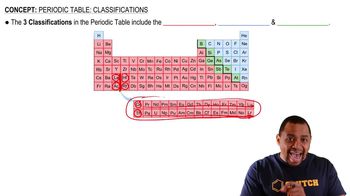
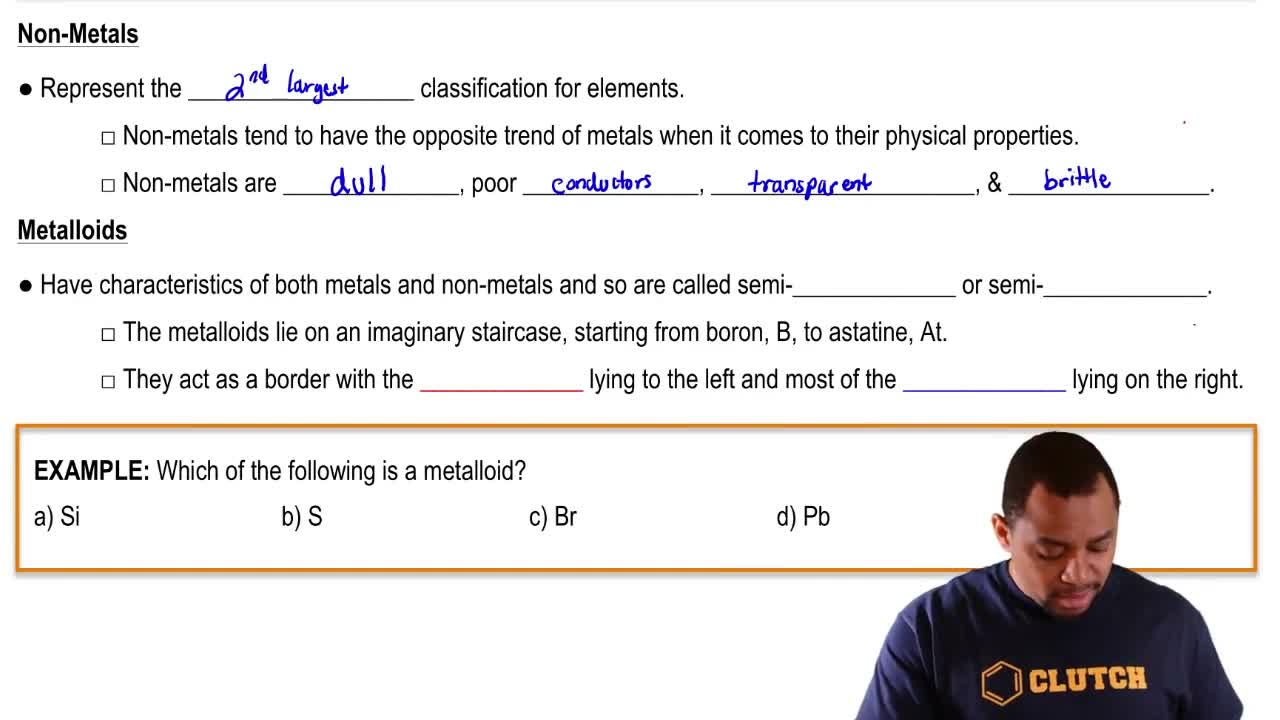
Metals: Left side of the periodic table, tend to lose electrons
Nonmetals: Right side, tend to gain or share electrons
Transition Metals: Middle of the periodic table
Atomic Mass
Average mass of an element's isotopes (amu)
Molar Mass
Mass of one mole of a substance (g/mol)
Mass Spectrometry:
Technique to determine the masses and relative abundances of isotopes
Mole (mol)
Amount of substance containing 6.022x10^23 particles (Avogadro's number).
1 mole = 6.022x10^23
Mole Conversions
Grams to Moles: grams ÷ molar mass = moles
Moles to Grams: moles × molar mass = grams
Moles to Particles: moles × 6.022 ×10^23
Particles to Moles: particles /6.022×10^23
Ionic Bond:
Metal + Nonmetal; electrons are transferred (e.g., NaCl)
Covalent Bond:
Nonmetal + Nonmetal; electrons are shared (e.g., H2O)
Ionic Compound:
Contains ions (e.g., NaCl); the smallest unit is a formula unit
Molecular Compound:
Atoms connected by covalent bonds (e.g., CO2); the smallest unit is a molecule
-Use prefixes to indicate number of atoms (e.g., CO2: carbon dioxide)
Molecular Elements
Some elements exist naturally as molecules, especially the seven diatomic elements: H2, N2, F2, O2, I2, Cl2, Br2.
Memory trick: Have No Fear Of Ice Cold Beer
Empirical Formula
Simplest whole-number ratio (e.g., CH2O)
Molecular Formula
Actual number of atoms in a molecule (e.g., C6H12O6)
Structural Formula
Shows how atoms are connected (e.g., H–O–H for water).
Formula Mass: Sum of atomic masses in a chemical formula.
1. Find atomic mass of each element
2. Multiply by number of atoms
3. Add together
Example: H2O: (2 × 1.01) + 16.00 = 18.02 g/mo
Mass percent is the percentage of a compound's mass from one element:
Mass % = (mass of element in compound/total mass of compound) × 100
Example: If oxygen is 16 g in a 20 g compound: 16/20 x 100 = 80%
Finding an Empirical Formula
1. Convert grams to moles
2. Divide by the smallest number of moles
3. Get whole numbers
4. Write the empirical formula
Example: C = 1 mol, H = 2 mol, O = 1 mol → CH2O
Combustion analysis
determines the formula of a compound by burning it and measuring the amounts of CO2 and H2O produced. This allows calculation of the empirical formula using mole ratios.
Metric Prefixes
Giga(G) = 10^9
Mega(M) = 10^6
Kilo(k) = 10^3
Deci(d) = 10^-1
Centi(c) = 10^-2
Micro(u) = 10^-6
Nano(n) = 10^-9
Pico(p) = 10^-12
Formulas
D = m/V
m = DxV
V = m/D
Molecular Compounds
1- mono
2 -di
3 -tri
4 -tetra
5 -penta
6 -hexa
7 -hepta
8 -octa
9 -nona
10 -deca