 Indietro
Polyatomic Ions in General Chemistry
 01:16
01:16
Termini in questo insieme (20)
A polyatomic ion is a charged species composed of two or more atoms covalently bonded that act as a single ion.
Polyatomic ions consist of multiple atoms bonded together with an overall charge, while monatomic ions are single atoms with a charge.
Nitrate ion.
The sulfate ion has a charge of 2-.
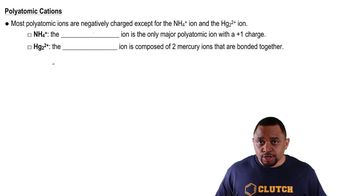
The ammonium ion is \(\mathrm{NH_4^+}\).
Hydroxide ion.
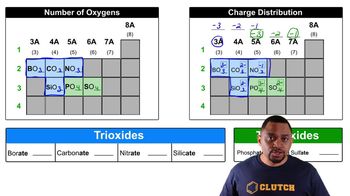
They are called oxyanions, and their names often end with -ate or -ite depending on oxygen content.
Nitrate (\(\mathrm{NO_3^-}\)) has one more oxygen than nitrite (\(\mathrm{NO_2^-}\)).
The carbonate ion has a charge of 2-.
Phosphate ion.
The chlorate ion is \(\mathrm{ClO_3^-}\).
It appears as a group of atoms in parentheses with a charge, e.g., \((\mathrm{SO_4})^{2-}\).
Acetate ion is \(\mathrm{C_2H_3O_2^-}\) or \(\mathrm{CH_3COO^-}\) with a charge of 1-.
Nitrite (\(\mathrm{NO_2^-}\)) and nitrate (\(\mathrm{NO_3^-}\)) both have 1- charge.
The permanganate ion has a charge of 1-.
The sulfite ion is \(\mathrm{SO_3^{2-}}\).
Use parentheses around the polyatomic ion if more than one is needed, e.g., \(\mathrm{Ca(OH)_2}\).
The cyanide ion is \(\mathrm{CN^-}\) with a charge of 1-.
Dichromate ion.
Hydrogen carbonate (bicarbonate) ion \(\mathrm{HCO_3^-}\) has a charge of 1-.