Skip to main content
General Chemistry
Il mio corso
Impara
Preparazione agli esami
AI Tutor
Guide di studio
Soluzioni per libri di testo
Flashcard
Esplora
Prova l'app
Il mio corso
Impara
Preparazione agli esami
AI Tutor
Guide di studio
Soluzioni per libri di testo
Flashcard
Esplora
Prova l'app
Indietro
Quantum-Mechanical Model of the Atom - General Chemistry
Puoi toccare per girare la carta.
What is the wave–matter duality concept?
Puoi toccare per girare la carta.
👆
What is the wave–matter duality concept?
Subatomic particles like electrons exhibit both particulate (mass, volume) and wave-like energy characteristics depending on experimental conditions.
Avanzamenti del tracciato
I pulsanti di controllo sono stati cambiati in modalità "navigazione".
1/20
Video consigliati
VideoThumbView.guidedCourse
2:58
Electromagnetic Waves
9982
views
201
rank
2
comments
VideoThumbView.guidedCourse
00:31
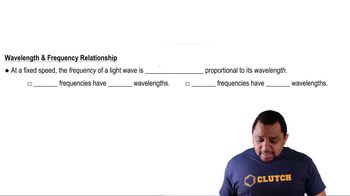
Frequency-Wavelength Relationship
7201
views
106
rank
VideoThumbView.guidedCourse
00:59
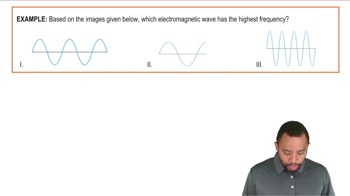
Wavelength and Frequency Example
10745
views
161
rank
Termini in questo insieme (20)
Nascondere definizioni
What is the wave–matter duality concept?
Subatomic particles like electrons exhibit both particulate (mass, volume) and wave-like energy characteristics depending on experimental conditions.
Why can't electrons in atoms be directly observed?
Electrons are so small that observing them changes their behavior, even shining light on them affects their state.
What does the quantum mechanical model say about electrons in atoms?
Electrons are not particles orbiting the nucleus but exist as a cloud of most probable positions described by wave nature.
What are the two perpendicular components of electromagnetic radiation?
Electric field component and magnetic field component oscillate perpendicular to each other and the direction of travel.
Define wavelength and amplitude of a wave.
Wavelength (λ) is the distance between successive crests; amplitude is the wave's height, related to light intensity.
How do wavelength and amplitude affect light properties?
Wavelength determines color; amplitude determines brightness.
What is frequency (ν) of a wave?
The number of waves passing a point per second, measured in hertz (Hz).
What is the relationship between wavelength and frequency?
They are inversely proportional; as wavelength decreases, frequency increases, with speed of light constant: \(\nu \lambda = c\).
What is the electromagnetic spectrum?
Range of all electromagnetic radiation wavelengths, from radio waves (long wavelength, low energy) to gamma rays (short wavelength, high energy).
What is the photoelectric effect?
Emission of electrons from a metal surface when light of sufficient frequency shines on it.
What did Einstein propose about light energy in the photoelectric effect?
Light energy is delivered in packets called quanta or photons, with energy proportional to frequency.
Write the formula relating photon energy to wavelength.
Photon energy: \(E = \frac{hc}{\lambda}\), where h is Planck's constant and c is speed of light.
What is the threshold frequency in the photoelectric effect?
Minimum frequency of light required to eject electrons from a metal surface.
What is the Bohr model's key idea about atomic energy?
Atomic energy is quantized; electrons orbit the nucleus in fixed energy levels or stationary states.
What is de Broglie's hypothesis about electrons?
Particles like electrons have wave-like properties, with wavelength inversely proportional to momentum: \(\lambda = \frac{h}{mv}\).
What does Heisenberg's uncertainty principle state?
It is impossible to simultaneously know both the exact position and velocity of a particle like an electron.
What are the four quantum numbers and what do they represent?
Principal (n): energy level; Angular momentum (l): orbital shape; Magnetic (m_l): orbital orientation; Spin (m_s): electron spin direction.
What shapes correspond to l = 0, 1, 2, and 3 orbitals?
l=0: s (spherical), l=1: p (dumbbell), l=2: d (cloverleaf), l=3: f (complex lobed shapes).
How many orbitals are in a subshell with angular momentum quantum number l?
Number of orbitals = 2l + 1.
What causes the lines in atomic emission spectra?
Electrons transitioning between energy levels emit photons with energy equal to the difference between levels, producing discrete spectral lines.
 IndietroIndietro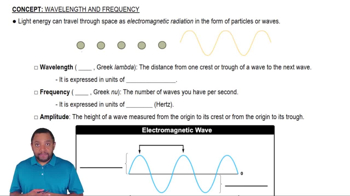
 2:58
2:58