 Indietro
Scientific Notation and Significant Figures in General Chemistry
 02:50
02:50
Termini in questo insieme (18)
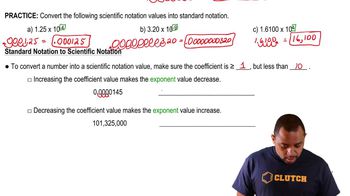
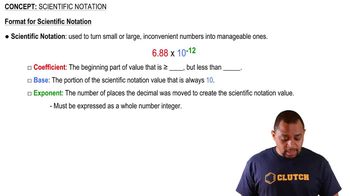
Scientific notation is a system for expressing very large or very small numbers as a simple number between 1 and 10 multiplied by 10 raised to an exponent.
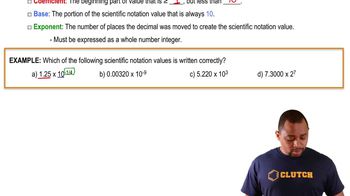
A number is written as \(y \times 10^x\), where y is the coefficient (1 to 10) and x is the exponent (positive or negative whole number).
A positive exponent means the number's magnitude is greater than one.
A negative exponent means the number's magnitude is less than one.
Move the decimal point to the right if the exponent is positive, or to the left if negative, adding zeros as needed to get the proper magnitude.
Significant figures are all digits known with certainty plus the first uncertain (estimated) digit in a measurement.
All nonzero digits and captive zeros (zeros between significant digits) are always significant.
No, leading zeros in decimal numbers less than 1 are not significant; they only position the decimal point.
Trailing zeros are significant only if the number contains a decimal point.
Three significant figures: 4, 5, and 8; the leading zeros are not significant.
1,500 has two significant figures; 1,500.00 has six significant figures because of the decimal point.
Align decimal points and limit the answer to the rightmost column where all numbers have significant figures.
Limit the answer to the lowest number of significant figures among the numbers used.
It clearly communicates the number of significant figures by including them in the coefficient.
4.5 × 10\(2\)
4.500 × 10\(2\)
38.65 has 4 significant figures; 105.93 has 5 significant figures.
Calculate the product and round the result to 4 significant figures, e.g., 4,094.1945 rounded to 4,094.