Indietro

SI Units, Unit Conversions, and Density in General Chemistry

I pulsanti di controllo sono stati cambiati in modalità "navigazione".
1/20
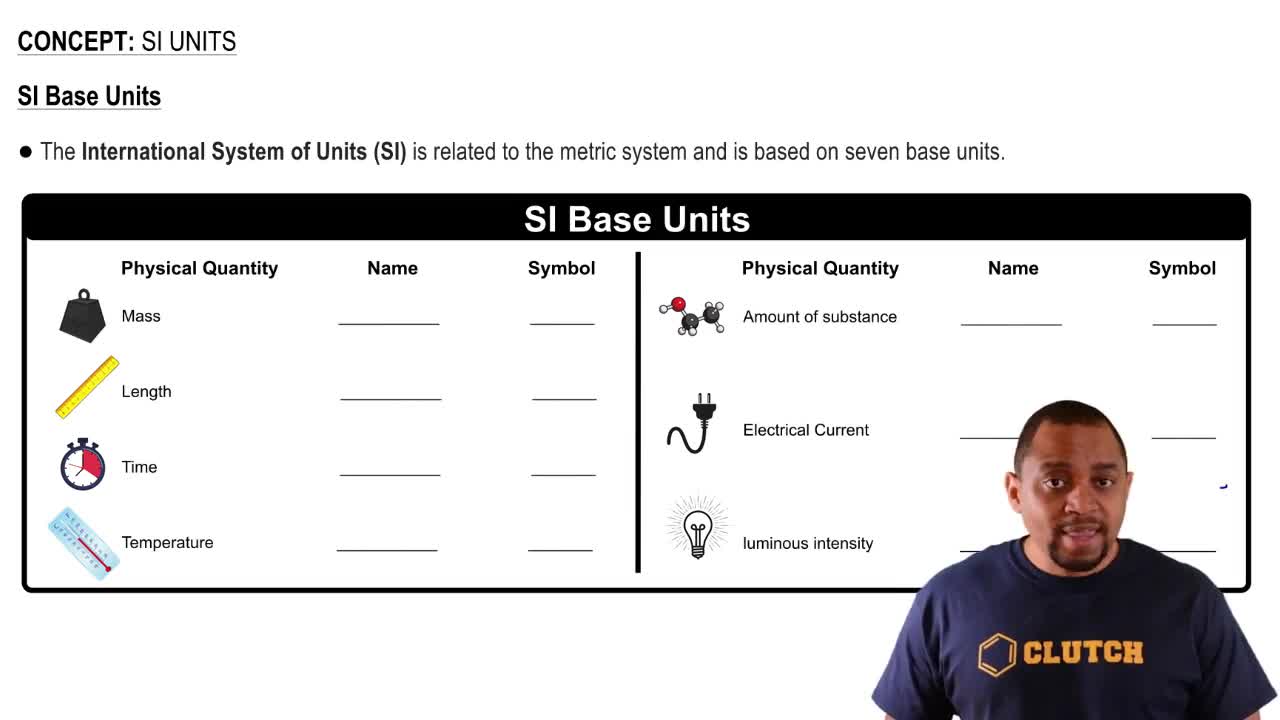
  • What are the seven base units of the International System of Units (SI)?

    • Length: meter (m)
    • Mass: kilogram (kg)
    • Time: second (s)
    • Amount: mole (mol)
    • Temperature: kelvin (K)
    • Electrical current: ampere (amp)
    • Luminous intensity: candela (cd)
  • What is the SI prefix and factor for 1,000,000,000 times the base unit?

    Prefix: giga (G), Multiplicative factor: 1,000,000,000 or \(10^{9}\)
  • What is the SI prefix and factor for 1/1,000,000 times the base unit?

    Prefix: micro (µ), Multiplicative factor: 1/1,000,000 or \(10^{-6}\)
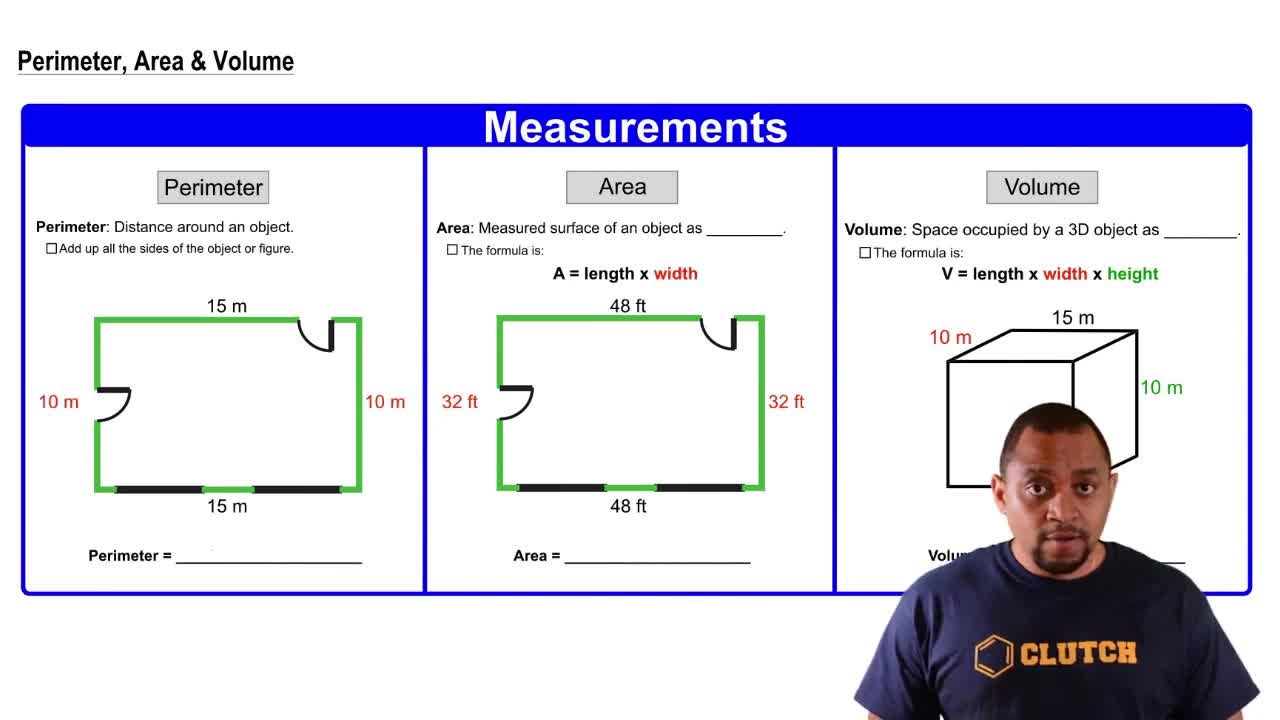
  • How is volume defined in terms of length measurements?

    Volume is the amount of space a substance occupies and is defined geometrically as length × width × height.
  • What volume does a liter represent in cubic centimeters?

    A liter is defined as a cube 10 cm on each side, so 1 liter = 1,000 cubic centimeters (cm³).
  • What is the relationship between a milliliter and a cubic centimeter?

    1 milliliter (mL) is equal to 1 cubic centimeter (cm³).
  • How is density defined in chemistry?

    Density is the mass of an object divided by its volume, describing the amount of matter in a given space.
  • What are the common units for density?

    Density units are typically grams per cubic centimeter (g/cm³) or grams per milliliter (g/mL).
  • Write the formula for density.

    \(\text{density} = \frac{\text{mass}}{\text{volume}}\)
  • How many meters are in 1 centimeter?

    1 cm = 1/100 m or 0.01 m.
  • What is a conversion factor?

    A conversion factor is a fraction with equivalent quantities in numerator and denominator expressed in different units, equal to 1.
  • How do you decide which conversion factor to use when converting units?

    Choose a conversion factor that cancels out the original unit and leaves the desired unit.
  • How do you convert 3.55 meters to centimeters?

    Multiply 3.55 m by the conversion factor \(\frac{100\,\text{cm}}{1\,\text{m}}\) to get 355 cm.
  • Why are numbers in conversion factors based on prefixes considered exact?

    Because they are defined or counted numbers, not measured, and have an infinite number of significant figures.
  • How do you convert 54.7 kilometers to millimeters in one step?

    Multiply 54.7 km by \(\frac{1000\,\text{m}}{1\,\text{km}}\) and then by \(\frac{1000\,\text{mm}}{1\,\text{m}}\) to get 54,700,000 mm.
  • What is the scientific notation for 54,700,000 millimeters?

    5.47 × 10\(7\) mm.
  • What is the rule for significant figures when performing multiple unit conversions?

    Perform all math steps first, then round the final answer to the correct number of significant figures.
  • What is the SI prefix for 1/10 of the base unit?

    Deci (d), with a multiplicative factor of 1/10 or \(10^{-1}\).
  • What is the SI prefix for 1/100 of the base unit?

    Centi (c), with a multiplicative factor of 1/100 or \(10^{-2}\).
  • How do you set up a unit conversion problem?

    Write the given quantity, multiply by the appropriate conversion factor with the unit to convert to on top, and cancel units to solve.