 Indietro
Atoms and Elements: Foundations of Modern Atomic Theory
Guida di studio - Note intelligenti
 Appunti personalizzati basati sui tuoi materiali, ampliati con definizioni chiave, esempi e contesto.
Atoms and Elements
Definition of Atoms and Elements
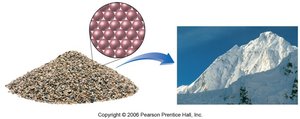
Atoms are the smallest particles of matter that retain all the properties of an element. An element is a fundamental form of matter composed of only one kind of atom. Elements are the building blocks of all substances in the universe.
Modern Evidence for the Atomic Theory
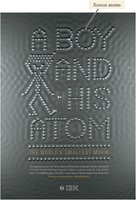
Modern technology, such as the scanning tunneling microscope (STM), allows scientists to manipulate and visualize individual atoms. For example, IBM scientists created the world's smallest movie, A Boy and His Atom, by moving atoms to form images and words, providing direct evidence for the existence of atoms.
Historical Development of Atomic Theory
Early Ideas: Aristotle and Democritus
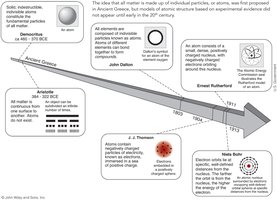
In ancient Greece, philosophers debated the nature of matter. Aristotle believed matter was infinitely continuous, while Democritus proposed that matter was composed of indivisible particles called atoms. These early ideas laid the groundwork for later scientific discoveries.
Key Laws Leading to Atomic Theory
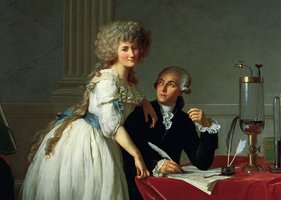
Law of Conservation of Mass: Matter is neither created nor destroyed in a chemical reaction. This principle, formulated by Antoine Lavoisier, states that the total mass of reactants equals the total mass of products in a chemical reaction.
Law of Definite Proportions: All samples of a given compound have the same proportions of their constituent elements, regardless of source or preparation method. This law was established by Joseph Proust.
Law of Multiple Proportions: When two elements form more than one compound, the masses of one element that combine with a fixed mass of the other are in ratios of small whole numbers. John Dalton formalized this law, providing strong evidence for the existence of atoms.
Dalton’s Atomic Theory
Postulates of Dalton’s Atomic Theory
John Dalton proposed a scientific atomic theory based on experimental evidence:
All matter is composed of indivisible particles called atoms.
All atoms of a given element are identical in mass and properties.
Atoms of different elements have different properties.
Atoms combine in simple, whole-number ratios to form compounds.
In chemical reactions, atoms are rearranged but not created, destroyed, or changed into atoms of other elements.
Discovery of Subatomic Particles
The Electron and Cathode Ray Experiments
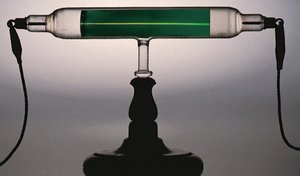
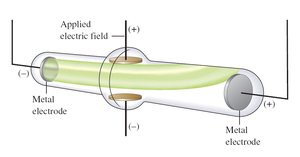
J. J. Thomson discovered the electron through experiments with cathode rays. He found that these rays were composed of negatively charged particles (electrons) that were much lighter than atoms. This led to the realization that atoms are divisible and contain smaller particles.
Plum Pudding Model
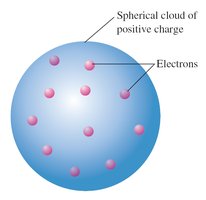
Thomson proposed the "plum pudding" model, in which electrons are embedded in a sphere of positive charge, like plums in a pudding.
Rutherford’s Gold Foil Experiment and the Nuclear Model
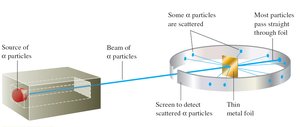
Ernest Rutherford’s gold foil experiment demonstrated that atoms are mostly empty space with a small, dense, positively charged nucleus at the center. Most alpha particles passed through the foil, but a few were deflected at large angles, indicating the presence of a nucleus.
Structure of the Atom
Subatomic Particles
Protons: Positively charged particles found in the nucleus.
Neutrons: Neutral particles found in the nucleus.
Electrons: Negatively charged particles found in the electron cloud surrounding the nucleus.
Atomic Number and Mass Number
Atomic Number (Z): The number of protons in the nucleus, which defines the element.
Mass Number (A): The total number of protons and neutrons in the nucleus.
For example, the element sodium (Na) has an atomic number of 11 and a mass number of 23.
Isotopes
Isotopes are atoms of the same element with different numbers of neutrons. They have the same atomic number but different mass numbers. The natural abundance of isotopes affects the atomic mass of an element.
The Periodic Table
Development and Structure
Dmitri Mendeleev organized the periodic table by increasing atomic mass, observing that elements with similar properties recur periodically. The modern periodic table is arranged by atomic number, with elements in columns (groups) and rows (periods).
Main Groups and Families
Alkali Metals (Group 1): Highly reactive metals, good conductors, malleable, ductile, and tend to lose electrons in reactions.
Alkaline Earth Metals (Group 2): Fairly reactive metals, less reactive than alkali metals.
Halogens (Group 17): Very reactive nonmetals.
Noble Gases (Group 18): Chemically inert gases, very stable and unreactive.
Metalloids: Elements with properties intermediate between metals and nonmetals, often semiconductors.
Atomic Mass and the Mole
Atomic Mass
The atomic mass of an element is the weighted average of the masses of its naturally occurring isotopes. It is listed under the element’s symbol on the periodic table and is measured in atomic mass units (amu).
The Mole and Avogadro’s Number
The mole is a counting unit in chemistry, defined as the amount of substance containing Avogadro’s number () of particles (atoms, molecules, or ions). One mole of an element has a mass equal to its atomic mass in grams.
Conversions Involving Moles
To convert between mass and moles:
To convert between moles and number of atoms:
Summary Table: Key Laws of Atomic Theory
Law | Description | Scientist |
|---|---|---|
Law of Conservation of Mass | Matter is neither created nor destroyed in a chemical reaction. | Antoine Lavoisier |
Law of Definite Proportions | All samples of a compound have the same proportions of their constituent elements. | Joseph Proust |
Law of Multiple Proportions | When two elements form more than one compound, the masses of one element that combine with a fixed mass of the other are in small whole number ratios. | John Dalton |
