 Indietro
Lec 7 notes chem
Guida di studio - Note intelligenti
 Appunti personalizzati basati sui tuoi materiali, ampliati con definizioni chiave, esempi e contesto.
Periodic Properties of the Elements
Introduction to the Periodic Law
The periodic law, first proposed by Dmitri Mendeleev in 1869, states that the chemical and physical properties of elements repeat periodically when the elements are arranged in order of increasing atomic number (Z). This foundational principle underlies the structure of the modern periodic table and explains recurring trends in atomic and molecular properties.
Trends in Atomic Properties
Atomic Size
The atomic radius is a measure of the size of an atom, typically defined as half the distance between the nuclei of two identical atoms bonded together. Atomic size can be described in several ways, including metallic, covalent, and van der Waals radii, depending on the context and bonding environment.
Metallic radius: Half the distance between nuclei in a metallic lattice.
Covalent radius: Half the distance between nuclei of two identical atoms joined by a covalent bond.
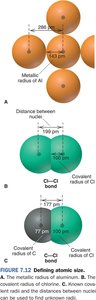
To understand trends in atomic radii, it is essential to consider the effective nuclear charge (Zeff), which is the net positive charge experienced by valence electrons. It is calculated as:
where Z is the atomic number and S is the number of core (shielding) electrons.
Across a period: Atomic radius decreases due to increasing Zeff, pulling electrons closer to the nucleus.
Down a group: Atomic radius increases as additional electron shells are added, increasing the distance from the nucleus.
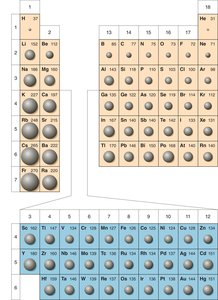
Example: Lithium (Li) is larger than beryllium (Be) across a period, but sodium (Na) is larger than lithium (Li) down a group due to the addition of electron shells.
Ionization Energy (IE)
Ionization energy is the energy required to remove an electron from an isolated gaseous atom or ion. It is a direct measure of how strongly an atom holds onto its electrons.
Across a period: IE increases due to increasing Zeff and decreasing atomic radius.
Down a group: IE decreases as atomic size increases and valence electrons are farther from the nucleus.
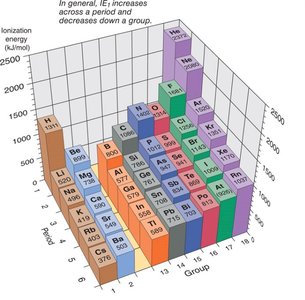
There are exceptions to these trends, such as between Be and B, due to electron configurations and subshell stability.
Successive ionization energies can be measured for each electron removed. There is a significant jump when core electrons are removed, reflecting their much greater binding energy.
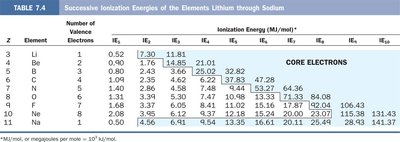
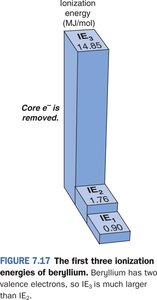
Example: For magnesium (Mg), the first and second ionization energies are relatively low, but the third is much higher, indicating the removal of a core electron.
Electron Affinity (EA)
Electron affinity is the energy change when a gaseous atom or ion gains an electron. It reflects the tendency of an atom to accept an electron.
Across a period: EA generally becomes more negative (more exothermic), indicating a greater tendency to gain electrons.
Down a group: EA generally becomes less negative (less exothermic), though there are exceptions.
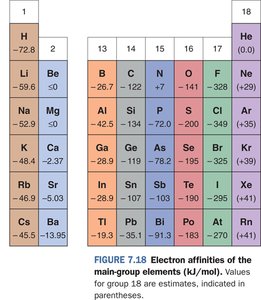
Example: Chlorine (Cl) has a high (very negative) electron affinity, meaning it readily gains electrons, while noble gases have positive or near-zero electron affinities.
Summary of Periodic Trends
Effective nuclear charge (Zeff): Increases across a period, slightly increases down a group.
Atomic radius: Decreases across a period, increases down a group.
Ionization energy: Increases across a period, decreases down a group.
Electron affinity: Becomes more negative across a period, less negative down a group.
Trends in Physical Properties
Melting Point, Boiling Point, Conductivity, and Hardness
Physical properties such as melting point (mp), boiling point (bp), electrical conductivity, and hardness depend on the type of structural entities (atoms, ions, molecules) and the interparticle forces present in a substance.
Melting and boiling points: Generally increase with stronger bonding and larger molecular/ionic structures.
Electrical conductivity: Metals conduct electricity well; nonmetals do not.
Hardness: Varies with bonding type; covalent networks (e.g., Si) are hard, while molecular solids (e.g., Ar) are soft.
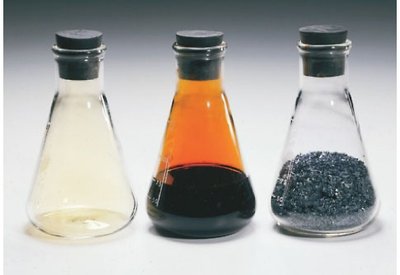
Example: Bromine (Br2) is a liquid at room temperature, interpolated between Cl2 (gas) and I2 (solid).
Trends in Chemical Properties
Metals vs. Nonmetals
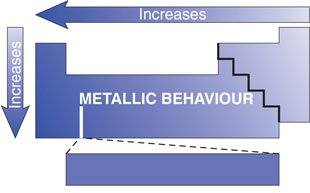
Metals tend to lose electrons (low IE, low EA), acting as reducing agents, while nonmetals tend to gain electrons (high IE, high EA), acting as oxidizing agents. Metallic character increases down a group and decreases across a period.
Metals: Good reducing agents, form basic oxides.
Nonmetals: Good oxidizing agents, form acidic oxides.
Redox Behavior and Electron Transfer
Redox (reduction-oxidation) reactions involve the transfer of electrons between species, resulting in changes in oxidation states. The substance that loses electrons is oxidized (reducing agent), and the substance that gains electrons is reduced (oxidizing agent).
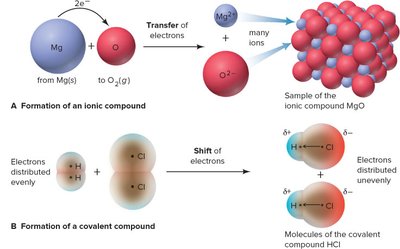

Example: In the reaction Na(s) + H2O(l) → NaOH(aq) + H2(g), sodium is oxidized and water is reduced. Alkali metals become more reactive down the group, acting as strong reducing agents.
Halogens are strong oxidizing agents, with reactivity decreasing down the group. Displacement reactions can be predicted by comparing oxidizing strengths (e.g., Cl2 can displace I– from solution).
Acid-Base Behavior of Oxides
Oxides of metals and nonmetals show distinct acid-base behavior in water:
Basic oxides: Metal oxides that react with water to form bases (e.g., Li2O, CaO).
Acidic oxides: Nonmetal oxides that react with water to form acids (e.g., SO3, P4O10).
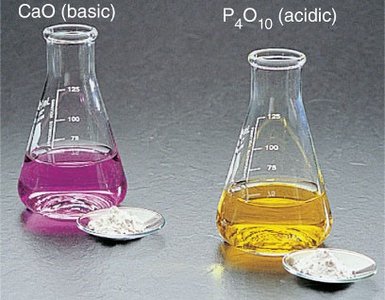
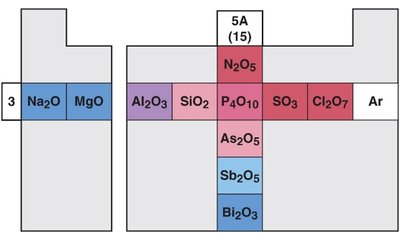
There is a gradual trend from basic to acidic oxides across a period:
Oxide | Type |
|---|---|
Na2O | Basic |
MgO | Basic |
Al2O3 | Amphoteric |
SiO2 | Weakly acidic |
P4O10 | Acidic |
SO3 | Acidic |
Cl2O7 | Acidic |
Example reactions:
Li2O(s) + H2O(l) → 2 LiOH(aq) (basic)
SO3(g) + H2O(l) → H2SO4(aq) (acidic)
Additional info: Amphoteric oxides (e.g., Al2O3) can react as either acids or bases, depending on the reaction conditions.
