Ch.1 - Introduction: Matter, Energy, and Measurement
Brown - Chemistry: The Central Science 14th Edition
Brown14th EditionChemistry: The Central ScienceISBN: 9780134414232Non è quello che usi tu?Cambia libro di testo
Capitolo 1, Problema 56a

(a) The speed of light in a vacuum is 2.998×10⁸ m/s. Calculate its speed in miles per hour.

Guida verificata passo dopo passo
1
Identify the given speed of light in a vacuum: \(2.998 \times 10^8\) meters per second (m/s).
Convert meters to miles. Use the conversion factor: 1 mile = 1609.34 meters.
Convert seconds to hours. Use the conversion factor: 1 hour = 3600 seconds.
Combine the conversion factors to convert the speed from meters per second to miles per hour.
Perform the unit conversion by multiplying the speed in m/s by the conversion factors to obtain the speed in miles per hour.

Risposta video verificata per un problema simile:

Questa soluzione video è stata consigliata dai nostri tutor come utile per risolvere questo problema.
Durata del video:
3m

Concetti chiave

Ecco i concetti essenziali che devi comprendere per rispondere correttamente alla domanda.

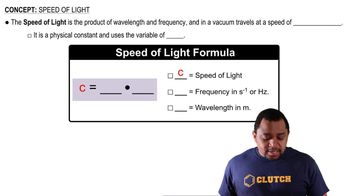
Speed of Light

The speed of light in a vacuum is a fundamental constant of nature, denoted as 'c', with a value of approximately 2.998×10^8 meters per second. This speed is crucial in physics and chemistry as it represents the maximum speed at which information or matter can travel. Understanding this constant is essential for calculations involving electromagnetic radiation and relativistic effects.
Video consigliato:
Percorso guidato
00:57
Speed of Light Formula

Unit Conversion

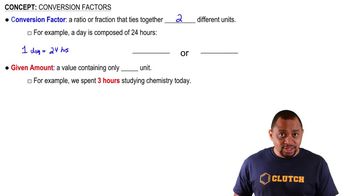
Unit conversion is the process of converting a quantity expressed in one set of units to another set of units. In this case, converting the speed of light from meters per second to miles per hour involves using conversion factors, specifically that 1 mile is approximately 1609.34 meters and 1 hour is 3600 seconds. Mastery of unit conversion is vital in chemistry for ensuring that measurements are consistent and comparable.
Video consigliato:
Percorso guidato
01:56
Conversion Factors

Dimensional Analysis

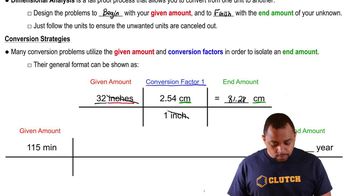
Dimensional analysis is a mathematical technique used to convert one set of units to another by multiplying by conversion factors that equal one. This method ensures that the units cancel appropriately, leading to the desired unit in the final answer. It is a powerful tool in chemistry for verifying calculations and ensuring that equations are dimensionally consistent.
Video consigliato:
Percorso guidato
06:11
Dimensional Analysis