The distance from Earth to the Moon is approximately 240,000 mi. (c) The speed of light is 3.00 ⨉ 108 m/s. How long does it take for light to travel from Earth to the Moon and back again?
Ch.1 - Introduction: Matter, Energy, and Measurement
Brown14th EditionChemistry: The Central ScienceISBN: 9780134414232Non è quello che usi tu?Cambia libro di testo
Tutti i libri di testo
Brown 14th Edition
Ch.1 - Introduction: Matter, Energy, and Measurement
Problema 73d
Brown 14th Edition
Ch.1 - Introduction: Matter, Energy, and Measurement
Problema 73dCapitolo 1, Problema 73d
The distance from Earth to the Moon is approximately 240,000 mi. (d) Earth travels around the Sun at an average speed of 29.783 km/s. Convert this speed to miles per hour.
Guida verificata passo dopo passo1
Identify the given speed of Earth around the Sun: 29.783 km/s.
Convert kilometers to miles using the conversion factor: 1 km = 0.621371 miles.
Convert seconds to hours using the conversion factor: 1 hour = 3600 seconds.
Multiply the speed in km/s by the conversion factor to get the speed in miles per second.
Multiply the speed in miles per second by the conversion factor to get the speed in miles per hour.

Risposta video verificata per un problema simile:
Questa soluzione video è stata consigliata dai nostri tutor come utile per risolvere questo problema.
Durata del video:
1mConcetti chiave
Ecco i concetti essenziali che devi comprendere per rispondere correttamente alla domanda.
Unit Conversion
Unit conversion is the process of converting a quantity expressed in one set of units to another. In this case, we need to convert the speed of Earth from kilometers per second (km/s) to miles per hour (mph). This involves using conversion factors, such as knowing that 1 kilometer is approximately 0.621371 miles and that there are 3600 seconds in an hour.
Video consigliato:
Percorso guidato
Conversion Factors
Speed and Velocity
Speed is a scalar quantity that represents the rate of distance traveled over time, while velocity is a vector quantity that includes both speed and direction. In this question, we are focusing on the speed of Earth as it orbits the Sun, which is essential for understanding how fast it moves through space, regardless of its direction.
Video consigliato:
Percorso guidato
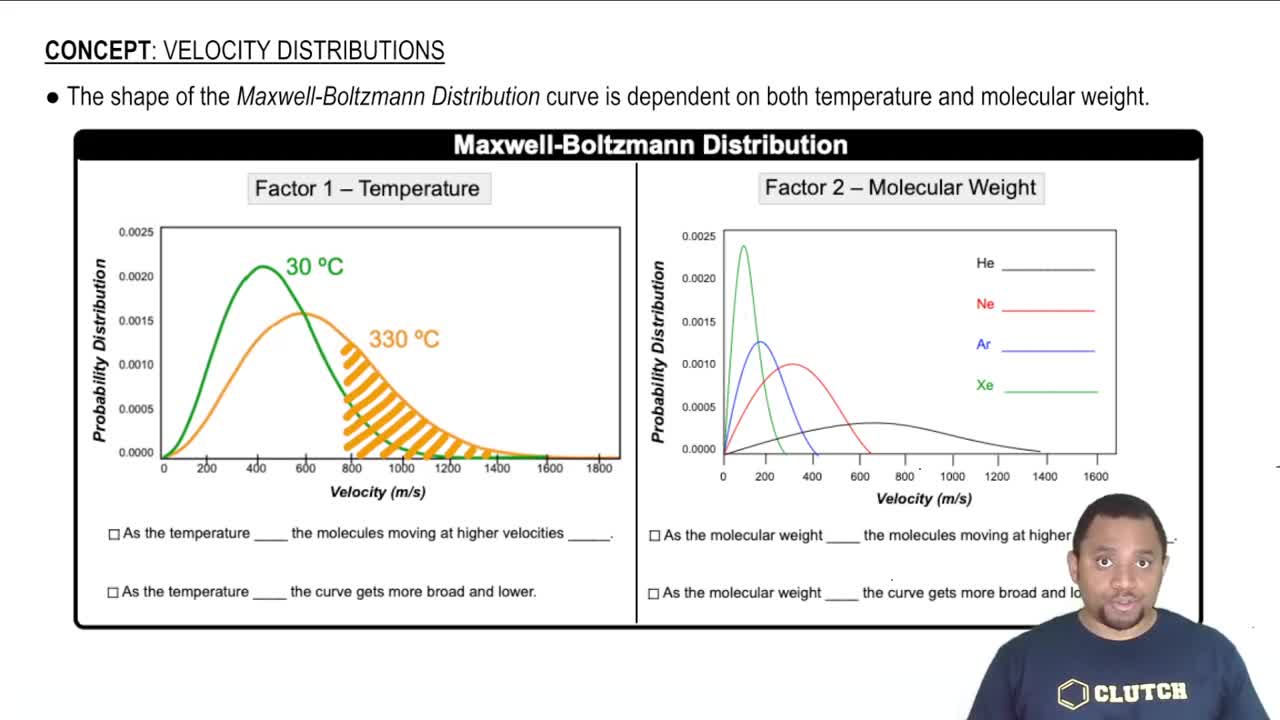
Velocity Distributions
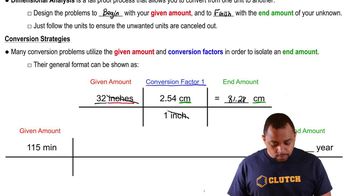
Dimensional Analysis
Dimensional analysis is a mathematical technique used to convert units and check the consistency of equations. It involves analyzing the dimensions of the quantities involved and ensuring that the units cancel appropriately. This method is particularly useful in physics and chemistry for verifying that calculations yield results in the desired units.
Video consigliato:
Percorso guidato
Dimensional Analysis
Pratica correlata
Domanda del libro di testo
616
views
Domanda del libro di testo
The distance from Earth to the Moon is approximately 240,000 mi. (a) What is this distance in meters?
1321
views
Domanda del libro di testo
Which of the following would you characterize as pure
or nearly pure substance? (a) stomach acid; (b) dry ice;
(c) ice-cream; (d) stainless steel; (e) petroleum; (f) distilled
water; (g) carbon monoxide gas; (h) compressed air in
balloon.
877
views
Domanda del libro di testo
The U.S. quarter has a mass of 5.67 g and is approximately 1.55 mm thick. (c) How much money would this stack contain?
903
views
Domanda del libro di testo
The U.S. quarter has a mass of 5.67 g and is approximately 1.55 mm thick. (a) How many quarters would have to be stacked to reach 575 ft, the height of the Washington Monument?
1587
views
Domanda del libro di testo
The distance from Earth to the Moon is approximately 240,000 mi. (b) The peregrine falcon has been measured as traveling up to 350 km/ hr in a dive. If this falcon could fly to the Moon at this speed, how many seconds would it take?
762
views