
Ch.1 - Introduction: Matter, Energy, and Measurement
Brown - Chemistry: The Central Science 14th Edition
Brown14th EditionChemistry: The Central ScienceISBN: 9780134414232Non è quello che usi tu?Cambia libro di testo
Capitolo 1, Problema 19a

The radius of an atom of tungsten (W) is about 2.10 A . (a) Express this distance in nanometers (nm). Express this distance in picometers (pm).

Guida verificata passo dopo passo
1
Understand the conversion relationship: 1 Ångström (A) is equal to 0.1 nanometers (nm).
Identify the given value: The radius of the tungsten atom is 2.10 Å.
Set up the conversion: Multiply the given value in Å by the conversion factor to convert it to nm.
Perform the multiplication: 2.10 Å * 0.1 nm/Å.
The result of the multiplication will give you the radius in nanometers.

Risposta video verificata per un problema simile:

Questa soluzione video è stata consigliata dai nostri tutor come utile per risolvere questo problema.
Durata del video:
3m

Concetti chiave

Ecco i concetti essenziali che devi comprendere per rispondere correttamente alla domanda.

Unit Conversion

Unit conversion is the process of converting a quantity expressed in one unit to another unit. In this case, we need to convert angstroms (A) to nanometers (nm). Knowing that 1 A equals 0.1 nm is essential for performing this conversion accurately.
Video consigliato:
Percorso guidato
01:56
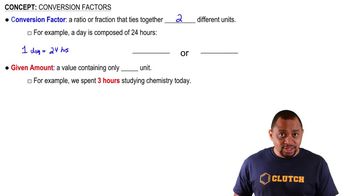
Conversion Factors

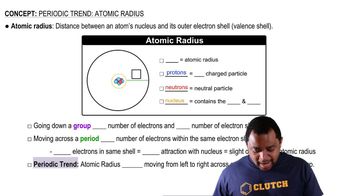
Atomic Radius

The atomic radius is a measure of the size of an atom, typically defined as the distance from the nucleus to the outer boundary of the surrounding cloud of electrons. For tungsten, the atomic radius is given as 2.10 A, which provides insight into its size relative to other elements.
Video consigliato:

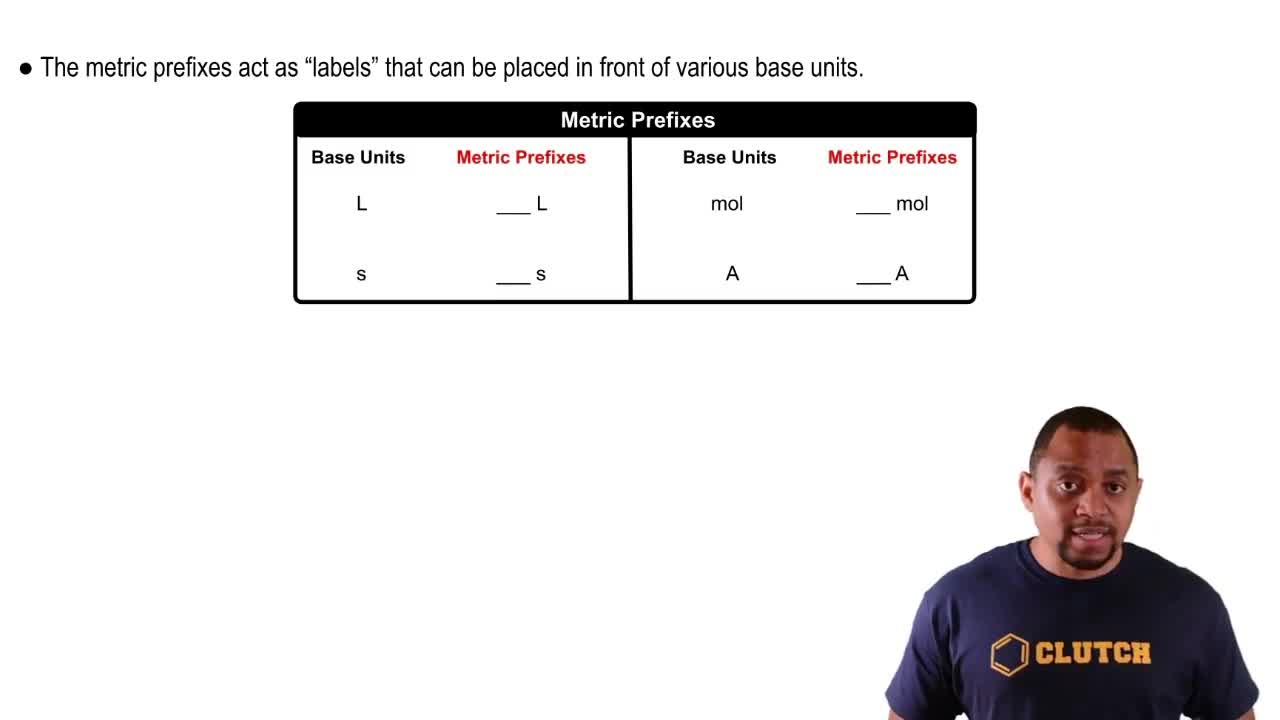
Metric Prefixes

Metric prefixes are used to denote multiples or fractions of units in the metric system. For example, 'nano-' denotes a factor of 10^-9. Understanding these prefixes is crucial for interpreting measurements and performing conversions between different scales, such as from angstroms to nanometers.
Video consigliato:
Percorso guidato
01:16
Metric Prefixes Usage
Pratica correlata
Domanda del libro di testo

A solid white substance A is heated strongly in the absence of air. It decomposes to form a new white substance B and a gas C. The gas has exactly the same properties as the product obtained when carbon is burned in an excess of oxygen. Based on these observations, can we determine whether solids A and B and gas C are elements or compounds?

1551
views
Domanda del libro di testo

(b) Which properties of zinc can you describe from the photo? Are these physical or chemical properties?

511
views
Domanda del libro di testo

Zirconia, an oxide of zirconium, is often used as an affordable diamond substitute. Just like diamond, it is a colorless crystal which sparkles under sunlight. Which of the following physical properties do you think would help in differentiating between diamond and Zirconia—melting point, density, or physical state?

985
views
Domanda del libro di testo

The radius of an atom of tungsten (W) is about 2.10 Å. (b) How many tungsten atoms would have to be lined up to create a wire of 2.0 mm?

809
views
Domanda del libro di testo

In the process of attempting to characterize a substance, a chemist makes the following observations: The substance is a silvery white, lustrous metal. It melts at 649 °C and boils at 1105 °C. Its density at 20 °C is 1.738 g/cm3. The substance burns in air, producing an intense white light. It reacts with chlorine to give a brittle white solid. The substance can be pounded into thin sheets or drawn into wires. It is a good conductor of electricity. Which of these characteristics are physical properties, and which are chemical properties?

1161
views
1
rank
Domanda del libro di testo

(a) Read the following description of the element zinc and indicate which are physical properties and which are chemical properties. Zinc melts at 420 °C. When zinc granules are added to dilute sulfuric acid, hydrogen is given off and the metal dissolves. Zinc has a hardness on the Mohs scale of 2.5 and a density of 7.13 g/cm3 at 25 °C. It reacts slowly with oxygen gas at elevated temperatures to form zinc oxide, ZnO.

866
views