(b) The lung capacity of the blue whale is 5.0×10³ L. Convert this volume into gallons.
Ch.1 - Introduction: Matter, Energy, and Measurement
Brown14th EditionChemistry: The Central ScienceISBN: 9780134414232Non è quello che usi tu?Cambia libro di testo
Tutti i libri di testo
Brown 14th Edition
Ch.1 - Introduction: Matter, Energy, and Measurement
Problema 54c
Brown 14th Edition
Ch.1 - Introduction: Matter, Energy, and Measurement
Problema 54cCapitolo 1, Problema 54c
Using your knowledge of metric units, English units, and the information on the back inside cover, write down the conversion factors needed to convert (c) mi to km
Guida verificata passo dopo passo1
Identify the conversion factor between miles and kilometers. The standard conversion is 1 mile = 1.60934 kilometers.
Set up the conversion equation using the identified conversion factor. If you have a distance in miles (mi), you can convert it to kilometers (km) by multiplying by the conversion factor.
Write the equation: \( \text{distance in km} = \text{distance in mi} \times 1.60934 \).
Ensure that the units cancel appropriately, leaving you with the desired unit of kilometers.
Apply this conversion factor to any given distance in miles to find the equivalent distance in kilometers.

Risposta video verificata per un problema simile:
Questa soluzione video è stata consigliata dai nostri tutor come utile per risolvere questo problema.
Durata del video:
1mConcetti chiave
Ecco i concetti essenziali che devi comprendere per rispondere correttamente alla domanda.
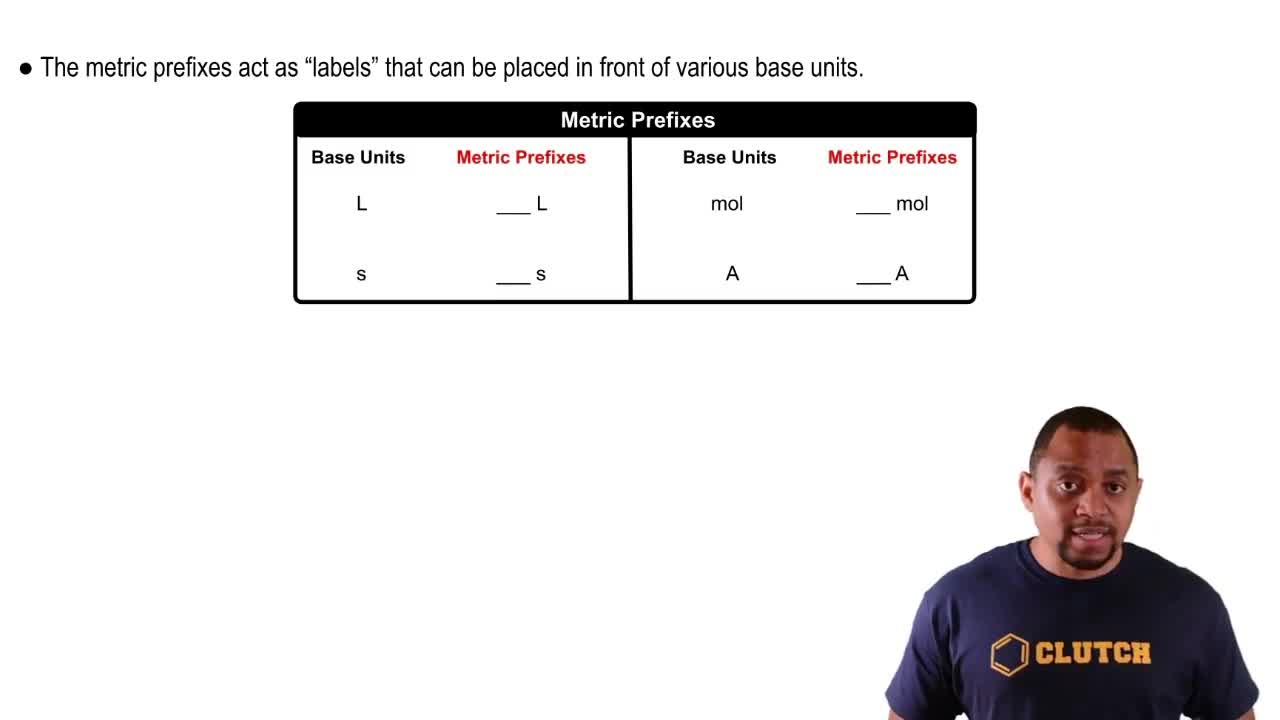
Metric and English Units
Metric units, such as kilometers (km), are part of the International System of Units (SI) and are based on powers of ten, making conversions straightforward. English units, like miles (mi), are part of the imperial system and do not follow a consistent base, requiring specific conversion factors to translate between systems.
Video consigliato:
Percorso guidato
Metric Prefixes Usage
Conversion Factors
A conversion factor is a numerical ratio used to express a quantity in one unit as an equivalent quantity in another unit. For example, to convert miles to kilometers, the conversion factor is approximately 1.60934 km per 1 mi, allowing for the accurate transformation of measurements between the two systems.
Video consigliato:
Percorso guidato
Conversion Factors
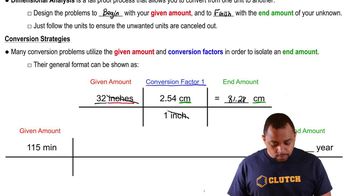
Dimensional Analysis
Dimensional analysis is a mathematical technique used to convert units by multiplying by conversion factors that cancel out the original units. This method ensures that the final result is expressed in the desired units, facilitating accurate calculations and understanding of the relationships between different measurement systems.
Video consigliato:
Percorso guidato
Dimensional Analysis
Pratica correlata
Domanda del libro di testo
1127
views
Domanda del libro di testo
Using your knowledge of metric units, English units, and the information on the back inside cover, write down the conversion factors needed to convert (d) in.3 to cm3.
404
views
Domanda del libro di testo
Using your knowledge of metric units, English units, and the information on the back inside cover, write down the conversion factors needed to convert (a) km/hr to m/s
Domanda del libro di testo
(a) A bumblebee flies with a ground speed of 15.2 m/s. Calculate its speed in km/hr.
902
views
Domanda del libro di testo
Using your knowledge of metric units, English units, and the information on the back inside cover, write down the conversion factors needed to convert (c) km to ft
457
views
Domanda del libro di testo
Using your knowledge of metric units, English units, and the information on the back inside cover, write down the conversion factors needed to convert (d) ft3 to L.
385
views