

Ch.10 - Gases
Brown - Chemistry: The Central Science 14th Edition
Brown14th EditionChemistry: The Central ScienceISBN: 9780134414232Non è quello che usi tu?Cambia libro di testo
Capitolo 10, Problema 121

A 4.00-g sample of a mixture of CaO and BaO is placed in a 1.00-L vessel containing CO2 gas at a pressure of 97.33 kPa and a temperature of 25 °C. The CO2 reacts with the CaO and BaO, forming CaCO3 and BaCO3. When the reaction is complete, the pressure of the remaining CO2 is 20.0 kPa. (a) Calculate the number of moles of CO2 that have reacted. (b) Calculate the mass percentage of CaO in the mixture.

Guida verificata passo dopo passo
1
Determine the initial moles of CO2 using the ideal gas law equation: PV = nRT. Here, P is the initial pressure, V is the volume, R is the gas constant (0.0821 L atm K^{-1} mol^{-1}), and T is the temperature in Kelvin.
Convert the initial pressure from kPa to atm for consistency with the gas constant units.
Calculate the final moles of CO2 remaining after the reaction using the final pressure, again converting this pressure to atm and using the ideal gas law.
Find the difference in moles between the initial and final CO2 to determine the moles of CO2 that reacted.
Assuming the reaction goes to completion and each mole of CaO and BaO reacts with one mole of CO2, use stoichiometry to relate the moles of CO2 reacted to the moles of CaO and BaO in the mixture. Then, calculate the mass percentage of CaO in the mixture based on the initial mass of the mixture.

Risposta video verificata per un problema simile:

Questa soluzione video è stata consigliata dai nostri tutor come utile per risolvere questo problema.
Durata del video:
13m

Concetti chiave

Ecco i concetti essenziali che devi comprendere per rispondere correttamente alla domanda.

Stoichiometry

Stoichiometry is the branch of chemistry that deals with the quantitative relationships between the reactants and products in a chemical reaction. It allows us to calculate the amounts of substances consumed and produced in a reaction based on balanced chemical equations. In this question, stoichiometry is essential for determining how much CO2 reacts with CaO and BaO to form CaCO3 and BaCO3.
Video consigliato:
Percorso guidato
01:16
Stoichiometry Concept

Gas Laws

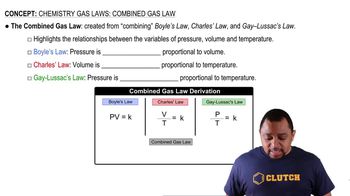
Gas laws describe the behavior of gases in relation to pressure, volume, and temperature. The ideal gas law (PV=nRT) is particularly useful for calculating the number of moles of gas present under specific conditions. In this scenario, the initial and final pressures of CO2 are crucial for determining how much CO2 reacted, which directly impacts the calculation of the mass percentage of CaO in the mixture.
Video consigliato:
Percorso guidato
01:43
Combined Gas Law

Mass Percentage

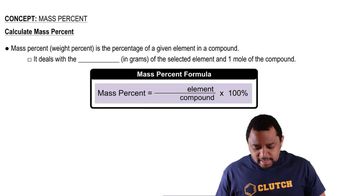
Mass percentage is a way of expressing the concentration of a component in a mixture as a percentage of the total mass. It is calculated by dividing the mass of the component by the total mass of the mixture and multiplying by 100. In this problem, calculating the mass percentage of CaO involves determining the mass of CaO that reacted with CO2 and comparing it to the total mass of the mixture.
Video consigliato:
Percorso guidato
00:38
Mass Percent Calculation
Pratica correlata
Domanda del libro di testo

Ammonia and hydrogen chloride react to form solid ammonium chloride: NH31g2 + HCl1g2¡NH4Cl1s2 Two 2.00-L flasks at 25 °C are connected by a valve, as shown in the drawing. One flask contains 5.00 g of NH31g2, and the other contains 5.00 g of HCl(g). When the valve is opened, the gases react until one is completely consumed. (a) Which gas will remain in the system after the reaction is complete?

882
views
Domanda del libro di testo

An herbicide is found to contain only C, H, N, and Cl. The complete combustion of a 100.0-mg sample of the herbicide in excess oxygen produces 83.16 mL of CO2 and 73.30 mL of H2O vapor expressed at STP. A separate analysis shows that the sample also contains 16.44 mg of Cl. (c) What other information would you need to know about this compound to calculate its true molecular formula?

679
views
Domanda del libro di testo

Ammonia and hydrogen chloride react to form solid ammonium chloride: NH3(g) + HCl(g) → NH4Cl(s)

Two 2.00-L flasks at 25 °C are connected by a valve, as shown in the drawing. One flask contains 5.00 g of NH3(g), and the other contains 5.00 g of HCl(g). When the valve is opened, the gases react until one is completely consumed. (b) What will be the final pressure of the system after the reaction is complete? (Neglect the volume of the ammonium chloride formed.)

4501
views
Domanda del libro di testo

An herbicide is found to contain only C, H, N, and Cl. The complete combustion of a 100.0-mg sample of the herbicide in excess oxygen produces 83.16 mL of CO2 and 73.30 mL of H2O vapor expressed at STP. A separate analysis shows that the sample also contains 16.44 mg of Cl. (b) Calculate its empirical formula.

1707
views