
Ch.10 - Gases
Brown - Chemistry: The Central Science 14th Edition
Brown14th EditionChemistry: The Central ScienceISBN: 9780134414232Non è quello che usi tu?Cambia libro di testo
Capitolo 10, Problema 17a

(a) How high in meters must a column of ethanol be to exert a pressure equal to that of a 100-mm column of mercury? The density of ethanol is 0.79 g/mL, whereas that of mercury is 13.6 g/mL. Assume that the density of the water is 1.00 5 1.00 3 103 kg/m3. The gravitational constant is 9.81 m/s2, and 1 Pa 5 1 kg/ms2.

Guida verificata passo dopo passo
1
Step 1: First, we need to convert the height of the mercury column from millimeters to meters. We know that 1 meter is equal to 1000 millimeters, so we divide 100 mm by 1000 to get the height in meters.
Step 2: Next, we calculate the pressure exerted by the mercury column using the formula P = ρgh, where P is the pressure, ρ is the density, g is the gravitational constant, and h is the height. We substitute the given values for the density of mercury (13.6 g/mL converted to kg/m^3), the gravitational constant (9.81 m/s^2), and the height we calculated in step 1.
Step 3: Now, we need to find the height of the ethanol column that would exert the same pressure. We rearrange the formula from step 2 to solve for h: h = P / (ρg). We know the pressure (it's the same as the pressure exerted by the mercury column), the density of ethanol (0.79 g/mL converted to kg/m^3), and the gravitational constant.
Step 4: Substitute the known values into the equation from step 3 to find the height of the ethanol column.
Step 5: The result from step 4 is the height of the ethanol column in meters that would exert the same pressure as a 100-mm column of mercury.

Risposta video verificata per un problema simile:

Questa soluzione video è stata consigliata dai nostri tutor come utile per risolvere questo problema.
Durata del video:
5m

Concetti chiave

Ecco i concetti essenziali che devi comprendere per rispondere correttamente alla domanda.

Hydrostatic Pressure

Hydrostatic pressure is the pressure exerted by a fluid at equilibrium due to the force of gravity. It is calculated using the formula P = ρgh, where P is the pressure, ρ is the fluid density, g is the acceleration due to gravity, and h is the height of the fluid column. This concept is essential for comparing the pressures exerted by different liquids, such as ethanol and mercury.
Video consigliato:

Density

Density is defined as mass per unit volume and is a critical property of substances that influences how they behave under pressure. In this problem, the densities of ethanol (0.79 g/mL) and mercury (13.6 g/mL) are used to determine how high a column of ethanol must be to exert the same pressure as a given height of mercury. Understanding density allows for the conversion between different fluid columns.
Video consigliato:
Percorso guidato
01:56
Density Concepts

Unit Conversion

Unit conversion is the process of converting a quantity expressed in one set of units to another. In this question, it is necessary to convert the height of the mercury column from millimeters to meters and to ensure that all densities are in compatible units (e.g., kg/m³). Mastery of unit conversion is crucial for accurately solving problems in physics and chemistry.
Video consigliato:
Percorso guidato
01:56
Conversion Factors
Pratica correlata
Domanda del libro di testo

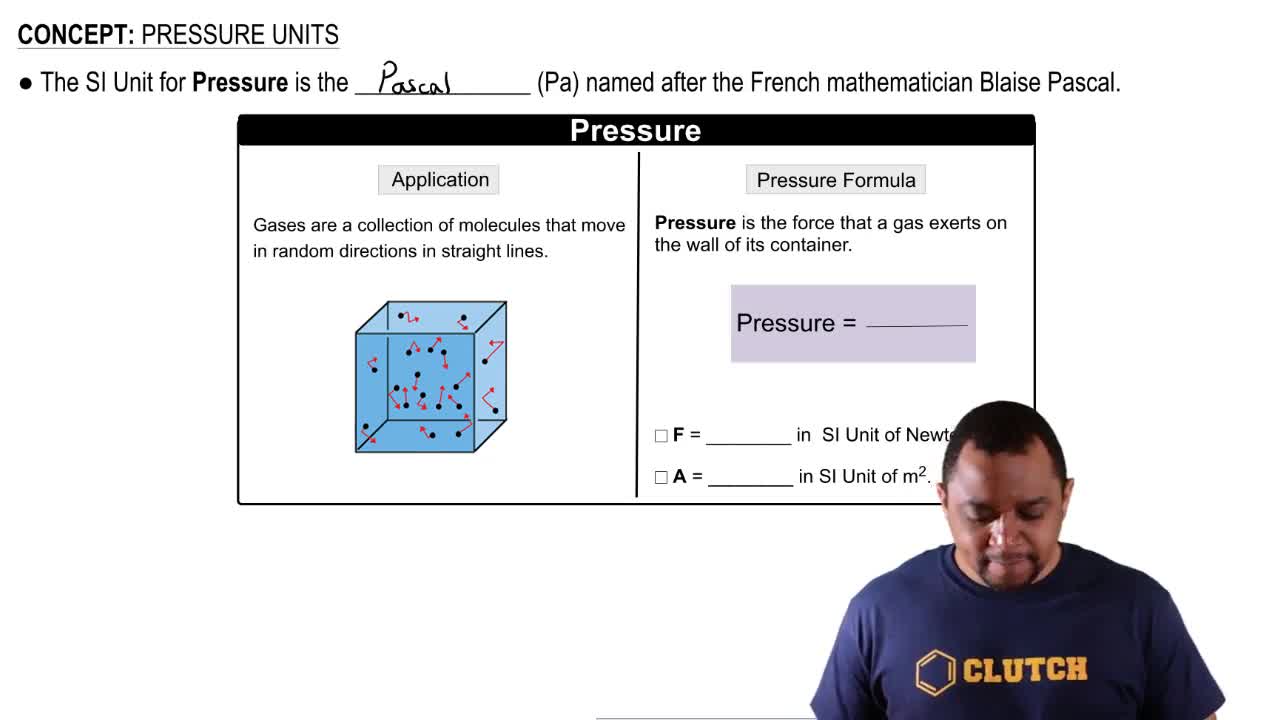
A person weighing 75 kg is standing on a threelegged stool. The stool momentarily tilts so that the entire weight is on one foot. If the contact area of each foot is 5.0 cm2, calculate the pressure exerted on the underlying surface in (b) atmospheres

Domanda del libro di testo

A person weighing 75 kg is standing on a threelegged stool. The stool momentarily tilts so that the entire weight is on one foot. If the contact area of each foot is 5.0 cm2, calculate the pressure exerted on the underlying surface in (a) bars

387
views
Domanda del libro di testo

(a) The compound 1-iodododecane is a nonvolatile liquid with a density of 1.20 g>mL. The density of mercury is 13.6 g>mL. What do you predict for the height of a barometer column based on 1-iodododecane, when the atmospheric pressure is 749 torr?

656
views
1
rank
Domanda del libro di testo

(b) What pressure, in atmospheres, is exerted on the body of a diver if she is 10 m below the surface of the water when the atmospheric pressure is 100 kPa? Assume that the density of the water is 1.00 5 1.00 3 103 kg/m3. The gravitational constant is 9.81 m/s2, and 1 Pa 5 1 kg/ms2

1815
views
Domanda del libro di testo

A person weighing 75 kg is standing on a threelegged stool. The stool momentarily tilts so that the entire weight is on one foot. If the contact area of each foot is 5.0 cm2, calculate the pressure exerted on the underlying surface in (c) pounds per square inch

504
views
Domanda del libro di testo

The highest barometric pressure ever recorded was 823.7 torr at Agata in Siberia, Russia on December 31, 1968. Convert this pressure to (b) mm Hg